Showing posts with label Andy Brack. Show all posts

Wednesday, May 2, 2012

Ruling in Abbeville v South Carolina is long overdue

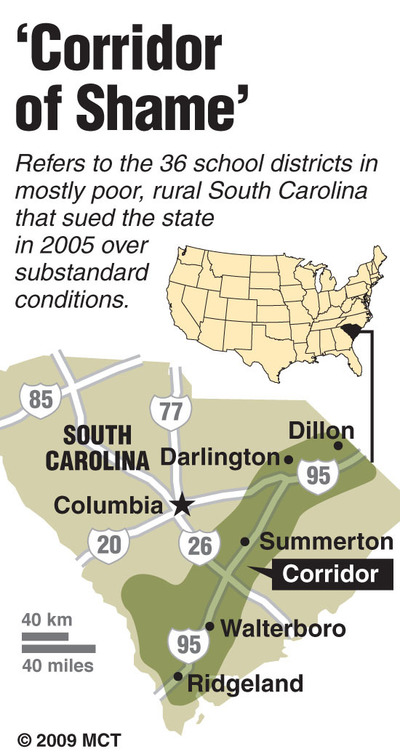
I've mentioned the Abbeville v South Carolina case several times before; it's the suit brought on behalf of several poor, rural school districts to force lawmakers to address inequity in school funding in our state, and it's the litigation at the heart of Bud Ferillo's documentary, "Corridor of Shame."

In the April 20 edition of the Statehouse Report, Andy Brack took up the topic and concluded that it's well past time for the state Supreme Court to have issued a ruling in this matter.

It takes four years for most high school students to graduate from high school. Most college students traditionally also graduate in four years.

But four years apparently isn’t enough time for the state Supreme Court to come to a conclusion about a festering school funding case first filed by poor South Carolina school districts in 1993. Yes, 1993. A student in first grade back then should, by now, be out of college and could even have a master’s degree. This thing has been going on that long.

In June 2008 -- a year before then Gov. Mark Sanford changed the definition of what it meant to “hike the Appalachian Trail” -- the S.C. Supreme Court heard oral arguments appealing a 2007 ruling on the Abbeville School District v. State of South Carolina case. Since then, an opinion has been pending. “We have no idea of knowing” when a decision will be rendered, a court spokesman said this week.

Really? After four years? The high court needs to get off of its robes and make a decision soon, particularly since state legislators now are gearing up to talk about (guess what?) revising the formula that funds public schools. Wouldn’t it be nice for legislators to have the court’s guidance on the constitutionality of issues related to public school funding before politically manipulating the formula so they don’t have to redo everything if the court rules for the poor school districts?

At issue is the case brought by poor, rural school districts like Abbeville County through the “Corridor of Shame” districts from Dillon to Ridgeland along Interstate 95. In essence, they complained 19 years ago that students in poor districts received a constitutionally-inappropriate and inadequate public education due to a variety of factors, most of which centered on funding.

By 1999, the state Supreme Court made a ruling in an appeal that set a standard for “minimum adequate education.” Before remanding the original case to the lower court to be considered again, it defined the standard “to include providing students adequate and safe facilities in which they have the opportunity to acquire: 1) the ability to read, write and speak the English language, and the knowledge of mathematics and physical science; 2) a fundamental knowledge of economic, social and political systems, and of history and governmental processes; and 3) academic and vocational skills.”

After a flurry of motions and filings, the circuit court then held 102 days of trial, starting in July 2003 and ending in December 2004. It heard 102 witnesses in person or by deposition, which generated a 23,100-page transcript. Some 4,400 documents were received in evidence. A year later, state Circuit Court Judge Thomas Cooper essentially ruled that the state provided a minimally-adequate education to students in the poor districts. But Cooper, now retired, required the state to fund early childhood intervention programs to satisfy constitutional requirements under the “minimally adequate” standard.

Cooper’s ruling didn’t make the plaintiffs or state happy. In 2006, both filed motions to get the court to change its 2006 order. Those motions were denied in July 2007. The following month, that decision was appealed to the state Supreme Court. In turn, it heard oral arguments on June 25, 2008 -- almost 46 months ago. Since then: not a word.

If the court’s not ready to rule yet, it might consider sending a signal that it still finds the case important by asking for further arguments, inviting additions to the record or accepting friendly opinions from interested parties.

But to do nothing is not in the interest of the public, especially in a state where legislators this year underfunded public education’s base student cost by about $700 million. This case is too important for today’s students to have to wait another generation for a ruling.

Monday, April 9, 2012

Haley opts for cant in her vanity project

"Cant" is defined at Dictionary.com thusly:

noun
1. insincere, especially conventional expressions of enthusiasm for high ideals, goodness, or piety.
2. the private language of the underworld.
3. the phraseology peculiar to a particular class, party, profession, etc.
4. whining or singsong speech, especially of beggars.

verb (used without object)
5. to talk hypocritically.
6. to speak in the whining or singsong tone of a beggar; beg.

All of which gives the reader the appropriate frame through which to view Governor Nikki Haley's vanity project, a mem-wah titled "Can't Is Not An Option."

Such doorstoppers have become de rigueur for aspring politicos. One can't be taken seriously as a candidate until one has published a book with a trite but lofty title. It somehow proves one's literacy, and it shows that one has the tenacity and determination to write two hundred pages on a topic, which is especially misleading when the topic is oneself.

Might it be a better use of a governor's time to serve as governor than to generate one's own pablum while serving in office? For a governor who likes to brag that she spends all of her days trying to bring economic development to South Carolina, she seems to have spent an inordinate chunk of the people's time drafting a pros-y self-portrait. Let's recall that soon after the announcement of her book deal, she was caught tapping on her iPad in the White House itself, during a speech to the nation's assembled governors by the President of the United States.

Which is the definition of gauche, it turns out.

In this week's edition of Statehouse Report, Charlestonian Andy Brack publishes a respectful and straightforward review of Haley's attempt -- which leads me to respect Brack even more, as I've not been able to bear looking at the thing.

Gov. Nikki Haley's new book is sure to cause three differing reactions:

Tea partiers will fall in love with Haley again for wearing their white hat and repetitively incanting the rhetoric of limited government that bashes the political establishment.

Mainstream Republicans and moderates will spend a lot of time rolling their eyes at the 200-plus pages of gratuitous, preening arrogance, inane recollections and my-way-or-the-highway declarations of revisionism.

Liberals won't be able to finish it because it's such an obvious political attempt to propel the governor to Washington, sooner as a vice-presidential candidate (despite lots of protest by her) or later as a U.S. senator.

If you like Haley and want to be pumped up, go ahead and spend $28 for what seems more like a transcribed version of a lot of self-taped conversations than a book. Otherwise, don't bother. Haley is trying too hard to be a real-life fairy tale.

Nevertheless, here are some observations of Haley's “Can't Is Not an Option:”

Childhood tale. The best part of the book is the beginning in which Haley delves into her childhood as a member of the only Indian family in Bamberg. She talks convincingly about challenges, goodness and the American Dream without too much tea party propaganda.

Philosophical insight. When you read about how Haley worked as a bookkeeper as a teen-ager for her mother's store, you get a better understanding of the anti-government rhetoric that fuels her politics. One such lesson:

“I learned early that we couldn't control our revenue stream – we couldn't control who decided to walk in the door of the store and spend their money. All we could control was our expenditures. So we were constantly focused on tightening our overhead. … I noticed how hard it was to make a dollar and how easy it was for government to take it away.”

What rankles about this statement by Haley, a self-professed policy wonk, is its naiveté about government. Unlike business, government can control revenue streams by raising or lowering taxes, or by providing incentives to bring in more businesses, all of which will increase the amount of money put in the state's pot.

Second, government can't always be run like a business, regardless of the GOP talking points. Sometimes, government is the only entity that's large enough or has enough of a cushion to do really big things, such as provide electricity to rural areas, build interstate roads, provide affordable college opportunities to millions, take care of the health of old people and more. For Haley, government is not a pathway to progress, but an impediment that has to be overcome. In the long term, that kind of vision of government isn't in South Carolina's best interest.

Courage. In the book, Haley often describes how she had courage to take on the establishment which “blackballed, demoted and humiliated” her for trying to get recorded roll call votes to boost accountability in the state House. Interestingly, she did not name the leader of the establishment, House Speaker Bobby Harrell, although she cut at him left and right for eight pages. Then in prose that would gag even a teen romance writer, she celebrated a “turnabout is fair play” moment as governor when she signed into law the bill she had pushed while in the House:

“The day didn't belong to me. It belonged to the people. I looked out and saw my parents, and I thought of what they had always taught me: If you fight for the right things, God will take care of the rest. It had taken a little while, but in the end my parents were right. The people had fought. Their cause was just. And now God was smiling down on South Carolina.”

Playing the victim. Haley also complained about people who saw themselves as victims, but within pages she would paint herself as a victim of Harrell, Gov. Mark Sanford or something else. After a while, it got more than a little monotonous.

Bottom line: Plant a garden. It's spring. There are better things to do than read this book.

Thursday, April 5, 2012

Brack, Free Times react to House voucher bill

Two sources I consult regular for clear-eyed reporting and commentary on the goings-on in Columbia are Statehouse Report, published by Andy Brack of Charleston, and the Free Times of Columbia.

Neither has disappointed in covering last week's passage of a voucher bill by the House.

From Statehouse Report comes this headline: "Back-door voucher bill defies logic."

If you ever thought the folks at the Statehouse take voters as “April fools,” just delve into a newly-passed House bill that seeks tax credits for parents who have kids in private school.

The House of Representatives has passed a so-called “school choice” bill that supporters claim gives parents more choice in education. Over the last few years, proponents have received more than $2 million to push the legislation from New York millionaire Howard Rich.

Meanwhile, opponents say the measure is a voucher in disguise -- a harmful way to siphon public money from public schools to weaken them more than they already are.

When proponents talk about “school choice,” they ignore the fact that public schools today offer more choices than ever before. Not only are there a plethora of charter schools all over the state, but there are magnet schools and programs, vocational tracks, Montessori-style instruction, online schools, arts-based schools and more.

Take note of that last fact, readers; you'll see it here again.

To suggest that public schools don’t offer choices to parents is outright wrong. But more importantly, the logic behind this move for more “school choice,” is fundamentally flawed.

Consider how the newly-passed House bill would allow tax deductions for parents’ income in three categories:
Up to $4,000 for parents who send their child to private school;
Up to $2,000 for parents who home-school their child; and
Up to $1,000 for parents who send their kids to a school in a district which is not their own school district of residence.

Now think about that. The measure is elitist on its face. Why? Because you need at least $4,000 in taxable income to take advantage of the tax deduction. But guess what? About half of South Carolinians make so little income -- or have enough tax breaks already -- that they pay absolutely no South Carolina income tax.

I think Rep. James Smith made the same point during the House debate, and he added that because of this fact, the bill under discussion amounted to no more than "gravy" for those wealthy enough to take advantage of it.

Let me run that by you again. Of the 2 million income tax returns filed in 2009, some 889,889 returns (43.7 percent) had absolutely zero tax liability. If you add another 131,592 returns where filers’ tax liabilities were $100 or less, then just over half -- 50.15 percent -- of filers paid $100 or less in S.C. income tax, according to the most recent numbers from the state Department of Revenue.

So do you really think people who don’t earn enough money to pay income taxes in South Carolina are going to benefit from a $4,000 tax deduction or have enough money to send their kids to private school? Heck no. But the legislature wants you to believe it is “looking out” for low-income people and trying to give them real choices.

Hogwash. This Republican-backed measure isn’t worth the paper it’s printed on. It’s nothing more than a way to help rich backers who want public money to help pay for private schools.

Various estimates suggest that between $7 million and $15 million has been donated to legislators and candidates, or used to mount propaganda campaigns, in support of the scheme.

The fiscal impact statement of the bill is estimated to cost the state $37 million in the first year, and more in subsequent years. I'd say that a lot of payback.

Jon Butzon of the Charleston Education Network said the House bill will harm public education.

“It’s only going to benefit a few and anybody who gets anything can already attend a private school,” he said. “The bigger issue is the General Assembly has a constitutional responsibility to every child of the state of South Carolina and it’s not meeting its responsibility.”

That responsibility, he said, is to fully-fund public education, as required by the state Education Finance Act. For the coming year, the House passed a $6.5 billion budget that underfunded public education by $700 million, or $1,002 per student.

So our lawmakers under-fund the base student cost by $1,002 per student, then moan and groan about the poor results coming out of public schools, and use them as justification for a voucher scheme that isn't paid for in our budget. This isn't public policy; it's a bad Three Stooges reel.

So while legislators plan to abrogate their responsibility to pay for public education as required by the law -- particularly laughable in a year when the state has a $900 million surplus -- they are also trying to sell the education moonshine of the need for tax deductions for people with kids in private school.

“They’ll sit up there and point the finger, but the Constitution says they’re responsible for every child,” Butzon noted. “This bill lets them off the hook to sell the smoke and mirrors that voters deserve a choice. Where is THAT in the Constitution?”

This House bill is a fraud that takes us all as April fools. Let’s hope the state Senate doesn’t fall for this illogical, vituperative political malarkey.

Amen. The State's "Buzz" author seems to think the Senate will bury it quickly, but I'll get to that in a minute.

Award-winning writer Corey Hutchens of the Free Times offered his own circumspection of the matter in this week's edition:

The Palmetto State has been a national flashpoint in the school choice movement since former Gov. Mark Sanford introduced the issue in 2004. In doing so, he attracted out-of-state pro-voucher forces whose outside money and hardball political tactics have become legend.

In 2009, Sanford’s lieutenants circulated a “hit list” of GOP incumbents who opposed school choice. Groups aligned with the issue recruited and funded primary challengers.

Gov. Nikki Haley, long a darling of the private school choice movement, said early in her administration that she won’t make the divisive issue a priority — but will sign a school choice bill if it makes its way to her desk.

In 2010, a Winthrop University poll showed likely voters in the state were evenly split on education tax credit proposals, which was a significant change from previously reported negative public perception.

Funny thing about polls is how the language of the questions often leads to pre-determined answers. Ask someone, "Would you support taking public dollars away from public schools?" and, if they support their local public schools, they may answer "No."

Now ask the same person, "Given that we spent roughly the gross national product of a Latin American nation on public education but haven't yet seen a graduate win a Nobel Prize, would you support giving state money to private schools where class sizes are small, school lunches are nutritious and children seem happy?" You might get a teary "Yes."

So I'm not that excited about polls unless I can read the questions and compare apples to apples.

Debbie Elmore, spokeswoman for the South Carolina School Board Administrators Association, who has fought such legislation for years, agrees that more lawmakers might have voted for it because it’s a “tamer” bill, but cites other reasons, too.

She blames outside school choice groups using what she calls bullying and harassment tactics to antagonize Republican lawmakers who oppose school choice, particularly in the Upstate.

During Sanford’s administration, the school choice debate made Howard Rich a household name. The wealthy New York City-based antigovernment activist dumped millions into South Carolina in support of school choice by funding SCRG and pro-voucher candidates.

One of former Democratic S.C. Superintendent of Education Jim Rex’s legacies was making the word “voucher” toxic when it came to school choice legislation. The language has since changed to “tax credits.”

This year, the national tea party-aligned FreedomWorks has zeroed in on certain lawmakers with phone calls and direct mail in their districts.

The efforts aren’t new, but are they finally paying off?

While Elmore won’t go that far, she says they’ve certainly taken their toll.

“I think that they’ve worn down the weary,” she says.

Wearing down the weary: Another tactic that doesn't lead to great public policy.

As I noted, The State seems to believe that the Senate will kill the voucher bill quick. True, the filing deadline for Senate races passed on March 30, so the voucherites don't have that to hold over Senators' heads. But a lot of Senators already have opposition, so we'll see.

Writes The State:

As any civics teacher can tell you, the role of a lower house – in South Carolina’s case, the state House – is to hotly reflect the desire of the public.

Now.

Elected every two years, House members cannot afford to be philosophical.

Even so last week’s S.C. House vote to start (it will never end) diverting state tax revenues – via tax deductions and credits – to parents who home school or send their children to private school was surprising.

No. 1: The voucher movement has been noisily renouncing any communal societal obligations – humbug!!! it’s failed!!! – for a decade.

No. 2: New York real estate millionaire Howard Rich and his friends have put nearly $2 million into S.C. political races over that decade to elect enough legislators – overwhelmingly Republicans – to turn the state into a K-12 lab experiment.

What’s surprising?

What took so long?

Lower houses, like the S.C. House, are the legislative equivalent of the grand jury that would indict a ham sandwich if a prosecutor said he – or she – wanted it. You, Joe or Mary Donor, or Bill or Sarah Voter want it? It’s part of the GOP agenda! You get it!

Of course, your civics teacher also would remind you that that is the proper role of a lower house, and the role of an upper house – in this case the famously deliberative S.C. Senate – is to sort the good ideas that the hotheads in the lower house have from the bad ones.

And it will.

(Heck, the S.C. Senate even kills good ideas that come from the House.)

Bottom line? The latest school choice bill will go nowhere this year. It felt good (in the House). But the Senate will kill this puppy so smoothly it won’t even yelp.

And, this being the end of a two-year session, after the bill dies in the Senate, it can all start again next year.

The Buzz sure hopes so.

South Carolina could use the added economic impact of Mr. Rich financing another 10 years of Palmetto State political races and blogs.

Must we suffer that injustice to reap economic growth?

I appreciate that The State added the vote breakdown, so we can see who did what on the fateful day.

For those of you keeping score, here’s how the House vote broke down:

For – 65 members, all Republicans – Rita Allison, R-Spartanburg; Todd Atwater, R-Lexington; Nathan Ballentine, R-Richland; Bruce Bannister, R-Greenville; Liston Barfield, R-Horry; Eric Bedingfield, R-Greenville; Kenny Bingham, R-Lexington; Don Bowen, R-Anderson; Bill Chumley, R-Spartanburg; Alan Clemmons, R-Horry; J. Berham Cole, R-Spartanburg; Tom Corbin, R-Greenville; Kris Crawford, R-Florence; Bill Crosby, R-Charleston; Joseph Daning, R-Berkeley; Greg Delleney, R-Chester; Tracy Edge, R-Horry; Shannon Erickson, R-Beaufort; Mike Forrester, R-Spartanburg; Mike Gambrell, R-Anderson; Dan Hamilton, R-Greenville; Nelson Hardwick, R-Horry; Bobby Harrell, R-Charleston; Jim Harrison, R-Richland; George Hearn, R-Horry; Phyllis Henderson, R-Greenville; William Herbkersman, R-Beaufort; Bill Hixon, R-Aiken; Chip Huggins, R-Lexington; Chip Limehouse, R-Charleston; Deborah Long, R-Lancaster; Phillip Lowe, R-Florence; Jay Lucas, R-Darlington; Peter McCoy, R-Charleston; Jim Merrill, R-Berkeley; D.C. Moss, R-Cherokee; Steve Moss, R-Cherokee; Chris Murphy, R-Dorchester; Wendy Nanney, R-Greenville; Ralph Norman, R-York; Phillip Owens, R-Pickens; Steve Parker, R-Spartanburg; Andy Patrick, R-Beaufort; Michael Pitts, R-Laurens; Tommy Pope, R-York; Joshua Putnam, R-Anderson; Rick Quinn, R-Lexington; Kevin Ryan, R-Georgetown; Gary Simrill, R-York; B.R. Skelton, R-Pickens; G. Murrell Smith, R-Sumter; G.R. Smith, R-Greenville; J. Roland Smith, R-Aiken; Mike Sottile, R-Charleston; Edward Southard, R-Berkeley; Kit Spires, R-Lexington; Tommy Stringer, R-Greenville; Eddie Tallon, R-Spartanburg; Bill Taylor, R-Aiken; Anne Thayer, R-Anderson; David Tribble, R-Laurens; Brian White, R-Anderson; William Whitmire, R-Oconee; Mark Willis, R-Greenville; Tom Young, R-Aiken

Against – 49 members, including five Republicans – Paul Agnew, D-Abbeville; Terry Alexander, D-Florence; Karl Allen, D-Greenville; Carl Anderson, D-Georgetown; Michael Anthony, D-Union; Jimmy Bales, D-Richland; James Battle, D-Marion; William Bowers, D-Hampton; Joan Brady, R-Richland; Lester Branham, D-Florence; Doug Brannon, R-Spartanburg; Curtis Brantley, D-Jasper; G.A. Brown, D-Lee; H. Boyd Brown, D-Fairfield; R.L. Brown, D-Charleston; Mia Butler Garrick, D-Richland; Bill Clyburn, D-Aiken; Gilda Cobb-Hunter, D-Orangeburg; Laura Funderburk, D-Kershaw; Wendell Gilliard, D-Charleston; Jerry Govan, D-Orangeburg; Chris Hart, D-Richland; Jackie Hayes, D-Dillon; David Hiott, R-Pickens; Kenneth Hodges, D-Colleton; Jenny Horne, R-Dorchester; Lonnie Hosey, D-Barnwell; Leon Howard, D-Richland; Joseph Jefferson, D-Berkeley; Kevin Johnson, D-Clarendon; Patsy Knight, D-Dorchester; David Mack, D-Charleston; Joe McEachern, D-Richland; Walt McLeod, D-Newberry; Elizabeth Munnerlyn, D-Marlboro; Jimmy Neal, D-Lancaster; Joe Neal, D-Richland; Denny Neilson, D-Darlington; Harry Ott, D-Calhoun; Julia Parks, D-Greenwood; Lewis Pinson, R-Greenwood; Todd Rutherford, D-Richland; Ronnie Sabb, D-Williamsburg; Bakari Sellers, D-Bamberg; James E. Smith, D-Richland; Leon Stavrinakis, D-Charleston; David Weeks, D-Sumter; Seth Whipper, D-Charleston; Robert Williams, D-Darlington
Friday, March 2, 2012

Brack: South Carolina can do better for its public schools

Andy Brack does a great job producing a handy legislative summary called Statehouse Report, and I've praised him for it many times before. In the current edition, he outdoes himself with a superb analysis of our lawmakers' unwillingness to meet their responsibilities when it comes to public education.

To wit:

Despite overwhelming evidence that investing more money in early childhood education will yield huge dividends in the lives of South Carolina’s children, the typical refrain from Republicans who lead the legislature is cold and disheartening: “Well, you just can’t keep throwing money at education. You just can’t.”

Ahem. Yes, you can. And yes, you should.

You can invest more money by paying teachers better than average. You can invest more to give them the support they need so they can teach. You can upgrade technology. And you can get rid of old schools that aren’t good enough to be used as warehouses.

Yes, South Carolina’s leaders can do more for her children, more than a half million of whom live in poverty.

See what I mean?

But what does the legislature do again, year after year? It tries to get education on the cheap. Why? It certainly doesn’t help that we rank 49th from the top in state and local tax burden and 50th in state tax collections per capita, according to the Tax Foundation. All of the wailing and moaning about high taxes in South Carolina is a bunch of ridiculous hooey. We have a stressed-out system of public education because our leaders aren’t bold enough to innovate or courageous enough to do what’s right for the 693,000 children in our schools.

If you asked a financial adviser to characterize a business strategy that relied on tucking away a little money every month for retirement, the adviser would immediately agree that it was a conservative business strategy.

If families can do that for retirement, why can’t our leaders invest in our people -- to ensure them a better chance in life, a chance that would pay off to all of us with lower rates of poverty, incarceration, drug use, welfare and on and on?

A substantial investment in early childhood education -- making it possible for every 4-year-old in the state to attend some kind of pre-kindergarten program -- would pay off massively. If the state spent just 10 percent of its enormous $900 million in new revenues this year, it could guarantee pre-K programs across the state.

And look at the payoff in reducing poverty and giving more people a chance, according to the Riley Institute’s Don Gordon:

“The Pew Foundation uses national data to show that for every $10,000 spent on high quality pre-kindergarten programs which render children more ready for school and less likely to drop out, we save society a quarter of a million dollars in a dropout’s reduced contribution to society,” he told a group of state leaders at a late February conference.

Furthermore, “According to the Alliance for Excellent Education, if the number of male South Carolina students who graduated from high school increased by just 5 percent, our state’s economy could see a combination of crime-related savings and additional revenue of $151 million each year.”

Unfortunately, South Carolina legislators continue to underfund public education, year after year. State law requires K-12 education to receive “base student funding” calculated through a long-accepted formula that may be due for an overhaul. But based on that formula over the last 20 years, state lawmakers have fully-funded education only five times.

If memory serves, those years were 1988, 1989, 1990, 1998 and 1999. If that's not accurate, I'd appreciate the correct data.

Last year, for example, the formula called for $2,790 in base student funding, but lawmakers provided about two thirds of that with $1,880 in funding, an improvement because the original plan was for funding to be $1,788 per student. (They upped the formula funding by moving around some funds and adding some one-time monies.)

For 2012-13, the House Ways and Means Committee is calling again for a base student cost of $1,788, which is $1,002 per student less than what is called for fully-funding education. If you extrapolate that to reflect the 693,431 students projected to be in public schools next year, lawmakers are considering a budget that would underfund South Carolina education by a whopping $694,817,862 less than the law requires.

Wow. And you wonder why South Carolina’s students lag the rest of the nation? Not investing $700 million a year certainly is one big reason. We can do better.

Wednesday, January 11, 2012

Will primary candidates visit Scott's Branch High School?

Statehouse Report editor Andy Brack offered a great suggestion for our hifalutin' guests arriving from New Hampshire this week. Among a list of places he recommends they visit while pressing the flesh and sipping sweet tea for the cameras is Scott's Branch High School. Writes Brack:

Scott’s Branch High School. An Upstate professor encouraged GOP candidates to visit Scott’s Branch High School in Summerton to better understand how segregation impacted the state -- and how the past still haunts the present. Scott’s Branch is a school highlighted in the Briggs v. Elliott court case, one of five consolidated into the Brown v. Board of Education in which the U.S. Supreme Court ruled segregation illegal.

Even today, conditions in “Corridor of Shame” schools from Dillon County to Jasper County along Interstate 95 generally are substandard to those in more affluent areas of the state. By visiting Scott’s Branch school, the professor explained, candidates would better understand how a quality education system is key for future generations to become more fully involved in the country’s economic system. In other words, a better education will lead to better jobs for all, but if we don’t invest in education, we won’t reap the rewards, particularly in rural areas.

Capital idea.

Given, however, that none of the candidates in question has made promotion of public education -- or the eradication of inequality in educational opportunity, for that matter -- the cornerstone of his campaign, I wouldn't hold my breath waiting for any of them to arrive in Clarendon County.

Wednesday, July 20, 2011

What is South Carolina's story?

Yesterday, I posted a note about an unfortunate letter written by a Charlestonian and published in Andy Brack's Statehouse Report. While the correspondent proposed sweeping the seamier facts and figures reflecting South Carolina's reality under the old rug, I suggested that we might be more authentic if we addressed those bad outcomes and changed our ways to make future reports better.

Brack published last week another item that speaks to the same issue: What to do about South Carolina's reality? He attended a forum sponsored by the Electric Cooperatives of South Carolina, where he heard Commerce Secretary Bobby Hitt, a former Australian premier, and a couple of public relations gurus discuss the question. Their suggestion: Rebranding.

Brack writes,

One of the first rules of politics is to define yourself and not let your opponent define you.

As a state, we've ignored this rule for too long. We've become frequent fodder for late-night comedians who poke fun at images we've brought upon ourselves -- from a philandering governor who redefined what hiking the Appalachian Trail means to the current lieutenant governor who can't seem to get his story straight on how he uses his campaign money.

One friend remarked years ago that the only time outsiders saw South Carolina in the news was about something bad -- either leaders in a pickle or when another embarrassing or bad statistic reared its ugly head.

So maybe it's high time that we devote some real effort into fixing South Carolina's image by giving ourselves a new brand. Let's make South Carolina mean more than the Palmetto tree and crescent moon logo that confuses most outsiders.

"We need to work a little bit on the good," S.C. Commerce Department chief Bobby Hitt said this week at a development forum put on by the Electric Cooperatives of South Carolina. "The bad and ugly are winning."

Mm. Sadly, the bad and the ugly are the doors we walk through to get to our own front porches. But I'm fully in support of Hitt's suggestion to work on the good. It's not enough to cut weeds off at the ground; you have to pull them up by the roots and replant something beneficial to the community.

But was Hitt -- and his co-panelists -- talking about digging up and replanting, or merely putting a privacy fence around our weedy lot and redirecting the public's eyes to the pretty fountain across the street?

Former Queensland Premier Peter Beattie, who was on the same panel, agreed. "Marketing can change South Carolina's image."

The state may be well on its way, in fact, by ripping off an idea from its sister state of Queensland. About a dozen years ago, Beattie said his state in Australia was down in the dumps like South Carolina is. To counter the image, Queensland started investing big in biotechnology and university research. It developed the concept of Queensland being the "Smart State" for research and development in the new economy.

In May, South Carolina's Centers of Economic Excellence program, which seeks top-notch academics to join Palmetto State research universities to drive economic development, changed its name to the SmartState Program, in part as a rebranding effort. Coincidence? No.

Sounds a lot like Research Triangle Park in North Carolina, the South's own "Smart State." Heavy investment in education, check. Biotechnology and university research, check. Developed the state as a center for research and development in a new economy, check.

Question: Are South Carolina's leaders willing to make the investment that Queensland and North Carolina made to birth a new South Carolina?

Prediction: Not hardly. But we can imagine -- briefly -- before the whistle blows and we have to punch in at the timeclock again.

Alas, the public relations gurus focused on devising a palette of lipsticks to use on the pig. There are so many choices, they said.

The value of fixing the state's brand can't be underestimated, according to two of the state's top marketing and advertising executives.

"We are not telling the full story about what South Carolina has to offer in areas like business, tourism, education and quality of life," said David Campbell, president of Columbia's Chernoff Newman agency. "The advantages [of branding] are that you get to control the story and get to help shape and realign perceptions by telling our unique characteristics. Disadvantages in today’s economic environment mean that there can be large costs associated with communicating through mass media. However, we must remain competitive so we can hardly afford not to. But you must have a clear vision about what you want to communicate. What is our story -- a pro-business state, a great place for tourism, a great place to live?"

Bruce Murdy, president of Rawle Murdy Associates in Charleston, said the state should tell its story strategically over a long term to shape how people think about the state.

"Every state has strengths and every state has its weaknesses, silly stories and attention-grabbing headlines from time to time," he said. "A good branding program isn’t about ‘glossing over’ issues as much as it can help refocus and put the spotlight on the great things our state has to offer.

"We’re a great vacation destination, and yet we’re so much more. So, do we let the media highlight our unemployment rate … or do we provide them great stories about BMW, Google and Boeing? Do we let the bloggers talk about our education challenges…or do we highlight what’s going on at ICAR, CURI and the Academic Magnet High School in Charleston? Do we let the headlines underscore our high obesity rates…or do we talk about the amazing discoveries at MUSC?"

Here's a thought: Bloggers talking about South Carolina's education challenges are not the problem. A self-perpetuating system of self-satisfied government that keeps South Carolina's children and public schools stuck in the Eisenhower era is.

And if the solution is to hold up BMW, Google and Boeing as our state emblems to redirect attention, let's beginning the planning now for the next of these forums in another decade, when we can repeat the whole conversation, yet again. Maybe then we can decide that to change perceptions, we might need to change reality.

Brack wraps it up smartly:

Bottom line: It's high time to redefine South Carolina. Our leaders need to invest in a smart, long-term strategy that will inform people about what we all know about the Palmetto State. And while they get smart people to spread the good word about South Carolina, maybe they can work seriously on bettering education, technology and workforce development that can turn around some of our bad statistics.

Tuesday, July 19, 2011

Disproportionate poor not to blame for South Carolina's ills

Readers of Andy Brack's Statehouse Report will recognize below a letter to the editor published in the most recent edition of that newsletter. (Those who do not subscribe are encouraged to do so.)

Since the young man signed his letter, it's revealing no secret to repost that information here:

To Statehouse Report:

I took note of your recent post ["The numbers tell a story of challenges," 6/25] listing the abysmal percentages that SC ranks in comparison to other states in certain categories. I am unclear on your intent and who your intended audience is in reporting this highly skewed and extremely pessimistic list, especially in the forum which you chose. How does a piece like this serve any positive purpose?

SC is a state complete with talented and educated people as well as unskilled and uneducated people ... as with every state. What SC does have, which is different than many other states, is a disproportionate percentage of a lower socioeconomic population (both black and white). It is very clear that a piece like this speaks heavily and directly to this economic and social class difference. To say that your “list” is a reflection on this lower class is accurate, but to say (and print) that this is a reflection of SC as a whole, is misleading and does the entire state and it’s educated population a huge disservice.

Others view SC as an uneducated and backwards state because that is the information that we provide to them. If we can begin to frame our negative statistics and attribute them to where they belong, you and others will see that we are not very different from other states and might even be a bit better.

-- Craig Delk, Charleston, SC

The summary of "abysmal percentages" to which Delk refers is found here, and I posted a similar set of abysmal data here.

It is easy to dismiss Delk's letter as the cranky angst of a promoter who wants to sweep our defects under the rug and focus attention only on South Carolina's sunny patina. But to dismiss it, I think, is a mistake; I suggest Delk's letter is worthy of intense consideration. In fact, the young man may be, perhaps unwittingly, giving voice to the base instincts of many others.

Consider his points:
-The list of data collected and published by Brack is "highly skewed and extremely pessimistic," he says. Delk does not question the data itself, only the collection and publication of it. Why? Because it is easier to criticize the dissemination of the information than it is to address the problems reflected by the data.

-South Carolina, like other states, is a mixture of "talented and educated" and "unskilled and uneducated people," but it suffers from "a disproportionate percentage of a lower socioeconomic population (both black and white)," he says. Delk offers no census data or other evidence to demonstrate the disproportionate percentage he perceives, and I have no interest in doing his research for him. But his assertion -- and his language -- is telling: Rather than face and address the individual South Carolinians reflected in Brack's summary of data, it is easier for Delk -- and likely of others who share his values, else he would not feel comfortable airing his view to a general readership of Brack's newsletter -- to group those individuals together and label them as he did, by their class. By establishing people of lesser means as a sort of "other" and grouping them together, it's easier to attach stereotypes to them, to dehumanize them, and to disregard their needs.

-Brack's summary of data, Delk writes, "speaks heavily and directly to this economic and social class difference." The charge -- a simple charge of "class warfare" -- underscores his earlier animus toward Brack's dissemination of information; to wit, Brack isn't interested in solving problems, he's engaging in class warfare, and for what purpose?

- Delk's next sentence is the revelatory one: "To say that your 'list' is a reflection on this lower class is accurate, but to say (and print) that this is a reflection of SC as a whole, is misleading and does the entire state and it’s educated population a huge disservice." Delk, speaking for himself but comfortably representing the view of friends and intimates, is offended that Brack or anyone else would post data reflecting the misfortune of others -- though they live in our communities, towns, cities, counties, and our state -- and leave open the possibility that readers outside our state would lump us all together. Underlying the offense is a well-known set of tropes: Education imputes rightness and, more importantly, goodness. Lack of education imputes wrongness and, indeed, badness. Good things come to good people, who deserve them for being good; bad things happen to bad people, who deserve them for being bad. Those of us who are educated, the logic follows, have a right to be offended when the other/bad/undeserving/lower socioeconomic class impedes our view of ourselves as a state. And we hold a special sense of offense when one we presume to come from our own class -- think of Franklin Roosevelt, called a "traitor to his class" -- like Brack, in this case, gins up a portrait that mars the view we hold of ourselves, as we represent our state.

-Delk repeats his point-of-view in his penultimate point: "Others view SC as an uneducated and backwards state because that is the information that we provide to them." Again, in his view, the data itself is not the problem; rather, the problem is the dissemination of the data.

But, in fact, the data is the problem. Observers don't see us as "uneducated and backwards" because that's the only face we show them. It's because that's our face.

For example, we chose to elect a state treasurer, Thomas Ravenel, some years ago who was criminally unsuited to the role, and was a cocaine dealer besides. I doubt it was our "disproportionate percentage of lower socioeconomic population" who forced him to traffic in cocaine, or even who elected him. Ruling them out leaves the guilt on the presumably educated class which Delk offers to represent.

Likewise, we elected a lieutenant governor, Andre Bauer, who drove recklessly through downtown Columbia and berated a police officer for applying the law equally to all citizens, and who later equated the poor to yard animals. We elected Governor Mark Sanford, who carried on an extramarital affair while in office, even sneaking out of the country to be with his mistress, and lying to us and everyone else. One of our elected representatives to Congress, Joe Wilson, shouted down the president of the United States in the middle of a live broadcast of a State of the Union address.

And it isn't just our elected officials; appointed ones have done their part, too. Only two years ago, a Columbia police officer found our assistant Attorney General Roland Corning parked in a cemetery with a prostitute -- or stripper, depending on which official source you consult -- and a variety of adult toys and Viagra in his car. Our assistant Attorney General explained that he "always had" these things in his car, "just in case."

Lest we mistakenly believe South Carolina's vulnerability to misfortune is a recent affliction, or an affliction of our "disproportionate percentage of lower socioeconomic population," we should consult history.

We elected Rep. Preston Brooks to Congress, who in 1856 beat down Sen. Charles Sumner of Massachusetts on the floor of the Senate with a walking cane -- beat him unconscious, and continued beating him -- leaving Sumner with permanent damage, so badly injured that he couldn't work for three years. We hailed Brooks as a conquering hero. A marble plaque in his honor is installed in the foyer of our Caroliniana Library on USC's Columbia campus.

We chose to secede from our nation, and persuaded other states to leave with us; it turned out badly for us and for them, yet we continue to honor and celebrate the cause for which we seceded. It's hard for out-of-state observers to ignore a state holiday -- or the flag we continue to fly in front of our State House.

We elected former Governor Ben Tillman to the U.S. Senate after he participated actively in the murders of innocent black militia members in Hamburg in 1876, and later made the entertaining and psychotic threat that he would drive a pitchfork through President Grover Cleveland's gut. And when he died, we erected a statue in Tillman's honor on the State House grounds, where it stands today.

When we were prohibited from keeping slaves, we excluded minorities as much as possible from our growing industrial economy, using impoverished women and children in our factories instead. We fought the progressive movement of the early twentieth century that led to child labor laws in other states, keeping our own 10-, 11- then 12-year-olds on mill payrolls until 1905.

Our elected lieutenant governor in 1903, James Tillman, angry at the truthful reports and editorials being published in The State newspaper, shot and killed, on the State House grounds, the newspaper's editor. He was appropriately charged with murder, but his uncle -- the same U.S. Senator who murdered innocents and threatened to maim a president -- intervened to move the trial from Richland County to Lexington County, and attended every day of it, at the end of which the jury unanimously voted the younger Tillman innocent of the charges.

We fought the campaign for a constitutional amendment allowing women the right to vote. Our legislature never ratified that amendment until 1969 -- 49 years after it became federal law without us.

When our mill workers sought to organize themselves as a union and negotiate for better working conditions, we watched them murdered in Honea Path in 1934, and we watched their factory shut down and themselves booted from their jobs in Darlington in 1956.

In part because of President Harry Truman's executive order integrating the armed forces, our Senator Strom Thurmond ran for president in 1948 on a segregationist platform. We and three other southern states gave him our electoral votes.

In 1952, in anticipation of Supreme Court rulings prohibiting segregation, we adopted a constitutional amendment empowering the legislature to close public schools, if necessary, to prevent integration. When the Court ruled in 1955 that racial segregation in schools was unconstitutional, our Governor Olin Johnston announced to a special session of our legislature that we, as a state, would defy that ruling. We appointed a School Segregation Committee, chaired by Senator Marion Gressette, to maintain that position for as long as possible. To honor Gressette for his long service, we named our state Senate Office Building for him.

Though we've existed as a colony, then a state, for 341 years, it was only 34 years ago that we adopted a law providing a formula and a mechanism by which to fund annually our state public school system. Yet even that proves too great a commitment; we've fully funded our own 34-year-old, outdated formula only a handful of times.

We were so preoccupied in the 1990s with maintaining the supremacy of the racist policies of our heritage that our lawmakers wasted months, perhaps years, of time debating the placement of the Confederate battle flag, which still holds a place of prominence on our Capitol grounds. So important was the single issue to us that it became a topic of conversation in the presidential primaries of 2000.

So peculiar is the issue of race in our history that a single impolitic remark about Strom Thurmond's run for the presidency cost Senate Majority Leader Trent Lott his party position. And so peculiar was it still that after Thurmond's death in 2003, we heard the rumors of a biracial daughter called, by our still-sitting Congressman Joe Wilson, a "smear on the image... [of] a person of high integrity who has been so loyal to the people of South Carolina." Indeed, the rumors proved to be accurate, and the granite base beneath the nine-foot-tall bronze statue honoring Thurmond was revised, with Essie Mae Washington Williams's name carved elegantly beneath the names of her much younger half-siblings.

And all of this occurred before our Governor Sanford carried two piglets up to the lobby outside the House chamber, where they soiled the rug, woven on historic looms at Oxford Mills of Mississippi, that had been installed as part of the multi-million-dollar restoration of the Capitol only a few years before.

It is arguable that none of these deeds or developments were the fault of South Carolina's "disproportionate percentage of lower socioeconomic population." Yet these are the pieces that give observers from outside South Carolina their view of our state.

In his final point, Delk proposes in his letter of criticism to editor Brack that we accentuate the positive, with regard to the awful data reflecting the status of South Carolina's poor and unfortunate: "If we can begin to frame our negative statistics and attribute them to where they belong, you and others will see that we are not very different from other states and might even be a bit better."

Sadly, neither lies nor obfuscation, nor ignoring, nor "reframing" facts and figures, will produce silk purses from sow's ears. Neither Brack nor the other sensible reporters and editors of our pitiful reality are to blame for what is. If our goal is to produce and disseminate news of wonderful outcomes, we as a state -- our educated middle- and upper-class, too -- might succeed by focusing on addressing our problems at their roots.

Monday, June 27, 2011

Brack catalogs evidence of state leaders' failures

It is always a pleasure to read work by Andy Brack, publisher of the "Statehouse Report" and occasional columns elsewhere, because his notes are run through with two interests: Educating South Carolinians about the state of their state, and motivating them to do better -- which often means, like it or not, exhorting them quietly to elect more conscientious, rather than simply committed, leaders.

"Conscientious" and "committed" mean two different things.

We've had our fill of leaders who were committed without being conscientious. They committed our state from its earliest years to a legacy of ignominy, and a quick survey of our state's highest-ranking electeds shows a who's-who of leaders in that mold.

We have a dearth, however, of conscientious leaders. Often in our history, the most conscientious of our leaders have gained office by accident and lost office at the next election. Or they've been trapped in a system designed purposefully to keep conscientious voices as quiet as possible.

Our wealth of committed and wholly unconscientious leadership can be measured, of course, by the state's treatment of its citizens. By "citizens," we include everyone who qualifies for that definition, not merely the old aristocratic meaning of the word: the wealthy, the landowning, the well-bred and genteelly-heeled.

In a note published in the Sumter Item, Brack catalogs those measurements.

Over the last three years, life in South Carolina has gotten slightly - but not significantly - better if you look at the latest demographic statistics. Despite some slight improvements, the state continues to have big challenges in education, health care, poverty and crime. Fortunately, we're not on the very bottom of most lists, as highlighted below:

No. 1 - South Carolina continues to lead the nation in violent crime, according to a 2011 Census report based on 2007 data. Domestic violence - the number of women killed by men - has dropped from seventh worst to ninth worst at 1.69 deaths per 100,000, according to the Violence Policy Center.

No. 2 and No. 3 - South Carolina ranked second worst in its SAT scores in 2010, according to the Commonwealth Foundation. While this is a slight drop, this measure is questionable because 18 of the 20 states with the best rates had participation rates of 7 percent or less, while 66 percent of South Carolina's students took the test. In other words, the cream of the crop in the best states took the SAT, while a majority of South Carolina's students did, which means comparisons are apples to oranges. On a better note, South Carolina's teachers ranked best in the nation in teacher quality, according to Education Week magazine in 2010.

No. 4 - The state ranks fourth worst in the percentage of babies born prematurely, the same ranking as a couple of years back. But in an encouraging trend, the rate - 14.3 percent - is improved by 1.3 percent, according to a March of Dimes study.

No. 5 - South Carolina shows up fifth highest on three health measures:

- Infant mortality. The rate is 8.6 infants per 1,000 infants dying, according to 2007 data. Earlier, the state ranked fourth highest.

- Low birthweight babies. Some 10.1 percent of Palmetto State babies are born with low weights, according to a 2010 report from the National Center for Health Statistics.

- Stroke. The state continues to rank fifth highest in stroke, but the death rate has gone from 58.5 victims to 57.6 victims per 100,000 people, according to the American Heart Association.

No. 6 - The state is the sixth worst place in the country for kids to grow up in, according to a 2010 KidsCount report. Still, that's an improvement over the #5 ranking from two years ago.

No. 7 - The state comes in seventh twice:

- Child deaths. South Carolina has the seventh highest rate of child deaths at 25 per 100,000 children. That's four slots worse than a couple of years ago, according to KidsCount.

- Unemployment. In May, according to the Bureau of Labor Statistics, South Carolina had a 10 percent unemployment rate, almost twice what it was three years ago, but still better than just a few months back.

No. 8 - The state is eighth on two big measures:

- Tobacco prevention. SC is tied for eighth in how much money it spent on tobacco prevention ($3.2 million a year, according to a June 2010 report from the Campaign for Tobacco Free Kids.) The good news? We used to be first. And the state's cigarette tax (57 cents per pack) is no longer the lowest in the nation, which averages $1.34 per pack.

- Diabetes. Some 10 percent of South Carolina adults have been told they have diabetes, the eighth highest average, according to a recent report by the Trust for America's Health.

No. 9 - The Palmetto State ranks ninth in two ways:

- Obesity. Slightly under 30 percent of South Carolina's adults are obese. That's better than the #7 ranking from two years ago. Then, however, 28.4 percent of residents were obese.

- Poverty. Some 15.7 percent of individuals in South Carolina live in poverty, tied with Alabama, according to 2011 Census data. But 22 percent of the state's children live in poverty, according KidsCount - the 11th highest number in the country.

Just about any way you cut the numbers, South Carolina still has a long way to go. Policymakers should take note.

Monday, June 20, 2011

Will Haley veto a plan to grant public schoolchildren more funds?

The Aiken Standard published a note today optimistic that our schools may get $56 million out of a conference committee agreement that irons out differences in the House and Senate budget plans. But the Standard is well aware that Governor Nikki Haley issued a declaration last week that public schools should get none of the late spring's windfall tax revenues.

It happens that Aiken County stands to collect two million dollars from the total sum, if it escapes Haley's wrath. And if that happens, the local school board may not be forced to raise the local millage rate.

If a S.C. legislative budget conference committee deal holds up, school districts would get an additional $56 million to boost their per-pupil allocations, including more than $2 million for the Aiken County School District.

The additional statewide funding is roughly half of the $105 million that the S.C. Senate had inserted into its budget initially after the Board of Economic Advisors projected another $210 million in new revenue.
...
Earlier this week, Gov. Nikki Haley said she would veto any additional funding for education.

As The Associated Press reported, the current per-pupil school allocation is $1,617 - more than $1,100 less than the state's own funding formula. Initial budget efforts improved the allocation to $1,788. The $105 million in extra appropriations would have move it to $1,959; the $56 million agreed upon by the committee will provide $1,880 per student.

Two of Aiken County's legislative delegation are tickled pink at the prospect of avoiding a millage increase: Reps. Bill Taylor and Roland Smith. But another two, Sens. Shane Massey and Greg Ryberg, take Haley's stand: In economic times such as these, children in the public schools have to suffer like the rest, and do more with less.

Ryberg, in fact, offered a colorful metaphor to illustrate his cold-hearted and cynical attitude toward the needs of children:

"The national economy is teetering toward a return to a recession," Ryberg said. "Squirrels have the sense to keep nuts for the winter."

Yes, summertime is precisely the time for Aiken County's children to forage for nuts and tuck them away in pencil boxes for those lukewarm Aiken County winter mornings to come. Ryberg assured the Standard he supports education, and the Standard gamely quoted him so:

"I'm fully supportive of education," said Ryberg. "But it's crazy to be in the same situation and face the same problems that we had four years ago when the downturn in the economy started."

He makes an excellent point. Many's the time during Senate budget debates past, when the state's economy was pink and the coffers were full, that our grave veteran Senators have intoned, Now is no time to spend money we have and commit ourselves to greater future obligations, even for the benefit of the little children of South Carolina.

Yet many's the time during Senate budget debates past, when the state's economy was bleak and the coffers were bare, that the same grave veteran Senators have moaned, Now is no time to spend money we don't have and commit ourselves to greater future obligations, even for the benefit of the little children of South Carolina.

It seems there is no good time to commit ourselves to a greater future, if doing it requires spending money.

Unless you live in North Carolina.

Andy Brack, publisher of an intelligent product called the Statehouse Report, included a noteworthy column in a recent edition. In it, he proposed that investing with perseverance in the things that matter can yield, over time, tremendous results. This is, of course, not new wisdom; Brack quoted the ancient philosopher Aesop, and used the fable of the crow and his pebbles to illustrate his point.

It seems entirely appropriate to offer Brack's example, given Ryberg's squirrels-with-nuts tangent, and another segment of his note:

If we want to do better on any of these measures, South Carolina has to make a sustained commitment to excellence and follow through like the crow. Two examples illustrate how perseverance pays off.

First turn to North Carolina. In the 1950s, some of Tarheel state's numbers, particularly on poverty and education, were as bad as -- if not worse -- than South Carolina's. But an inspirational leader, Terry Sanford, mustered the political muscle to invest big in public education, particularly at the university level. And a group of business, political and academic leaders worked together to create a research and development park that blended the resources of universities with the corporate sector. The result? Research Triangle Park, now the home to more than 170 global companies.

How did it happen? North Carolina's leaders dreamed, adopted a shared vision and persevered to make it happen.

A second example comes from the world of politics. Following Franklin D. Roosevelt's New Deal and the idealism of John F. Kennedy, Great Society naysayers concocted a political vision espousing government was bad for America. With the Watergate scandal injecting cynicism in a country still smarting from the clashes of the 1960s, the political environment was ripe for the message by Ronald Reagan that "government is the problem." In the years that followed, many politicians blindly adopted the mantra that the only way to get what's needed in America was to cut taxes, cut more taxes and cut more taxes -- to, in fact, cut government so much that conservative tax-hater Grover Norquist could "drown it in a bathtub."

The moral is that conservatives adopted a once-controversial political vision, but kept plugging away at it for years until that vision became the vision of the majority.

But in 2011, a vision to continue to cut taxes more is becoming ridiculous. With South Carolina having the dubious distinction of taking in the lowest amount of taxes per capita according to the Tax Foundation, we don't have much fat to cut. We're cutting into the bone.

Our state's leaders need to comprehend that South Carolina needs transformational change to survive. To persist in cuts on top of cuts will lead us to becoming a third-world state.

The root of the word "fable" is Latin and means "story." The word "fabulous" has the same root. If we want South Carolina's future story to be fabulous, we've got to become the crow and work hard to shrug off the hangovers of the past. Invest perseveringly. Dum spiro spero.

Of course, I prefer Brack's example to Ryberg's.

The question is, Is Nikki Haley going to be crow with wisdom, or a squirrel hoarding nuts?

Saturday, March 12, 2011

South Carolina finds rock bottom; lawmakers dig harder

Andy Brack, publisher of the Statehouse Report, announced in the current edition of Free Times that South Carolina has beaten every other state in the union in a key economic indicator: the amount of tax revenue collected by our state.

Four years ago, according to the nonprofit Tax Foundation, South Carolina collected an average $1,894 per person in tax revenues -- an astoundingly low number when considering that the average includes all of South Carolina's taxpayers who are millionaires. That figure ranked us 44th out of 50.

But last year, we beat that by more than $300, as the state collected an average $1,577 per person and left us holding 50th position, dead last.

Brack explains how difficult it was for South Carolina to earn the distinction.

Over the past five years, state lawmakers have passed tax cuts worth $640 million annually, which has led so far to $1.42 billion in lower state revenues in the same time span. And if you think government has grown massively, it hasn’t. The state’s budget has grown an average of 1.4 percent over the past 15 years — the same rate as population growth, according to state figures.

That was a heavy lift, indeed, and lawmakers deserve full recognition for their work.

Not everyone is crowing over the win, Brack writes. The late Governor Carroll Campbell's chief economist, Harry Miley, is "flabbergasted." Campbell and Miley, longtime residents will recall, did much to move South Carolina's economy into the twentieth century. Miley's tone is far from celebratory: "...dead last on paying for government services? That just doesn’t seem very smart in the long run. You can’t fund your infrastructure. Your infrastructure crumbles.”

Brack finds some lawmakers who aren't happy with the ranking either, finding the average collection per citizen not low enough.

So, with news from the Tax Foundation that we collected less per capita at the state level in 2009 and we have just about the lowest tax burden per capita of anyone, you’d think state lawmakers would be throwing some kind of party.

Nope: They want to lower those awful, high taxes more, as witnessed by legislation introduced by state Rep. Jim Merrill (R-Berkeley) to cut property taxes on “just about anyone who bought property in South Carolina after 2006,” according to a March 3 story in the Post and Courier. His biggest ally: South Carolina realtors. The cost: A cut to cities, counties and schools of another $220 million to $260 million at a time when their budgets are reeling, too.

When rock bottom isn't low enough, how do you get lower? You dynamite the rock and never mind the collateral damage.