Showing posts with label Charleston. Show all posts

Thursday, April 5, 2012

Peper finds examples of great teaching in Charleston

There are more than 50,000 great public school teachers in South Carolina. Highlighting each one of them with a column in one daily newspaper would take more than 137 years, but that doesn't mean we oughtn't do it from time to time.

I'm pleased to see that Post & Courier columnist Warren Peper took note of one last week, Mark Nadobny of Moultrie Middle School:

When you enter Mark Nadobny’s class at Moultrie Middle School, the number of signs and maps on the walls can be a bit overwhelming. The wall opposite the entrance shows a European map with sticky notes labeled “G,” “P,” “F,” “USSR” and “GB.” A poster directly across the room says, “Freedom isn’t free — just ask any soldier.”

Nadobny is the chair of the Social Studies department, and his passion is teaching history. His third-period class of seventh-graders starts at 9:52 a.m., and when it’s time to begin, you’d better buckle up.

The first 10 minutes of class is spent taking inventory of plastic bags various students have brought for a class project. Nadobny puts together care packages for soldiers serving overseas. As this day begins, he displays the toothpaste, candy, gum, shampoo, pencils and jelly beans some students have contributed. His lesson? During his deployments while in the Navy, there were always a couple of guys who never got anything during mail call. He wants his students to show the military serving overseas that people back here care.
Reveal and Review

For the next 10 minutes, students are asked to share any family stories pertaining to their current studies of World War II. A shy girl raises her hand to say her great-uncle was in Hawaii and saw Japanese planes approaching Pearl Harbor. Other class members mention specific moments their great-grandparents have shared with their families through the years. So far, we’re in class 20 minutes, and while no books are yet open, there’s some learning going on.

With the pacing of a game show host, Nadobny moves into what he calls “I Spy.” Using the classroom Smartboard, he begins to pepper the students with quick questions of review from the previous class. What was the Rome-Berlin-Tokyo Axis? Why is this a propaganda poster? He moves around the room so the students stay engaged. Claire, Brandon, Stan and Griffin all come up with correct answers, and they’re immediately tossed a Dum Dum lollipop. When this session is over, the teacher has cleverly avoided calling on anybody twice, and before you know it, virtually everyone in the class has a Dum Dum and they’re clearly Not Not.
Time to take notes

The final 20 minutes of class are spent on new information. Students are then led into an interactive narrative that involves words like blitzkrieg and the Nazi-Soviet Non-Aggression Pact. Again, Nadobny, in his seventh year at Moultrie Middle, navigates his way through the lesson plan with maps, posters, grease pencils and his computer-driven Smartboard. There’s no way anybody can sleep or disengage because he’s constantly on the move, calling on students and asking questions. They ask him, too. What does führer mean? The answer is leader. How old was Hitler? In his 40s, during WWII.

Before class is dismissed, it’s time to watch a Disney cartoon. Before you say, “What in the name of Mickey Mouse is going on here?” the cartoon is a production the U.S. government asked the Disney Co. to make that starred Donald Duck. It’s original title was “Donald Duck in Nutzi Land.” Yet another history lesson is squeezed in just before the bell rings.

Mark Nadobny’s love of history is very clear. His passion for sharing that love with his students reveals itself every time class begins.

Before his 17-year teaching career began, he was a signalman in the Navy. Then, his job was to receive and distribute messages. Looks like some middle-schoolers in Charleston County are fortunate he’s standing watch.

I’m just sayin’...

Wednesday, April 4, 2012

Burke students set examples, changed history

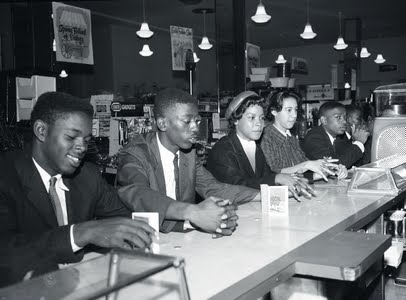
Thanks to the Charleston Post & Courier for this weekend feature article on the sit-ins of the 1960s at S.H. Kress on King Street and elsewhere.

What a tremendous message these events communicated: That high school students could and can, in fact, have a great impact on the history of their communities.

Today, I'm afraid to say, thanks to the super-saturation of pop culture, our high schoolers are more likely to know exactly the whereabouts of Justin Bieber or be retweeting the most recent emanations of Kim Kardashian than understand how our present governor is like an absentee landlord, or how their lawmakers have sold their votes to out-of-state ideologues, or what further actions are being taken in Columbia to limit our civic freedoms.

In short, I wish we had more students like Alvin Latten, David Richardson, Verna McNeil, Minerva Brown King and Fred Smalls.

Minerva Brown King sat silent as a waitress poured ammonia on the lunch counter in an attempt to force her to leave.

King, then a junior at Burke High School, didn’t move, and neither did any of the other 23 students who staged the first downtown sit-in of a segregated five-and-dime store, S.H. Kress.

“It was one of the catalysts for the change that eventually led to desegregated public accommodations,” said King, now a media specialist at St. John’s High School on Johns Island.

Today marks the anniversary of that April 1, 1960, sit-in at the King Street building that now houses upscale household goods retailer Williams-Sonoma.

The event was significant because it showed that youths were politically active at an earlier age than some previously thought, said Jon Hale, an assistant professor of education at the College of Charleston who studies the history of education. It also showed that protests among high school students played an integral although overlooked role in the overall Civil Rights movement, Hale said.

The April 1 sit-in served as the precursor to a broader Civil Rights movement in the community.

“They taught the lesson of, ‘We can do this, and we’re not too young,’” Hale said. “It set an example for others to follow. It was more of an ideological victory.”

Some of the Burke High School students involved continued the fight for equal rights. Harvey Gantt, for example, went on to become the first to integrate Clemson University, in the winter of 1963.

Another student involved was Cecelia Gordon Rogers, then a senior at Burke. She has lived most of her life in Charleston, and she has been one of the primary forces behind Charleston Development Academy, a small charter school that mostly serves students in the surrounding housing project. Rogers is the school’s principal.

The April 1 sit-in and other experiences during the Civil Rights movement helped shaped her to become the kind of person who can’t sit idle on the sidelines, she said.

“There was a sense of hopefulness that we would end up with a better community, a more cohesive community,” Rogers said. “I just wanted to be a part of making things different.”

King was the daughter of J. Arthur Brown, then the Charleston NAACP president, and the sit-in was the first time she participated in an organized event without her family’s knowledge.

She and other members of the youth Charleston NAACP met for weeks to prepare, role-playing scenarios and learning how to react to physical abuse and verbal threats.

Students picked April 1 because they wouldn’t have school. It also happened to be exactly two months after four college students staged the historically significant sit-in at the Woolworth’s store in Greensboro, N.C.

On April 1, 1960, Burke High students dressed in their Sunday best. King wore a garnet two-piece wool suit. They originally set out for Woolworth’s, but word of their effort had leaked and they weren’t able to sit at the counter, King said.

Their back-up plan was Kress, and the store’s workers had no idea they were coming. Students took up more than half of the lunch-counter seats, and managers took the tops off the remaining seats so no one else could join them.

Students tried to order but were refused service. They were told to leave but they refused. They were threatened with arrest but they didn’t budge.

They didn’t talk, other than to say the Lord’s Prayer or recite Psalm 23, “The Lord is my shepherd, I shall not want.” They stayed for more than 5½ hours before police arrested them.

“There was never fear,” King said. “I guess you can call it apprehension, because you just never know how people are going to react, but I don’t remember ever being afraid. I think I felt excitement that we were becoming a part of the movement that would become national. It was positive, and it felt good that we as young people were taking the initiative to do this.”

It was a time that King and Rogers remember vividly and still talk about today.

“It really was for a cause,” Rogers said.

Sunday, March 25, 2012

Supporters propose a memorial for Judge J. Waties Waring

Here's wonderful opportunity to do a good thing for our state, our children and ourselves. I hope our state's educators will support this wholeheartedly and actively.

I've written several times to praise Judge J. Waties Waring of Charleston, a man whose leadership did much to change -- against the wishes of Charleston society -- the course of South Carolina's and America's history.

In this week's edition of Statehouse Report, editor Andy Brack brings the great news that Waring may finally be memorialized with a monument on the federal courthouse grounds in the Holy City.

Notice, however, that the monument would stand on federal courthouse land, not state property. Alas, while we continue to honor the memories of murderous governors and racist senators on our State House grounds, there is not yet room for a good man of egalitarian principle. Perhaps in another century.

A generation of South Carolinians -- maybe two -- have grown up without knowing much about a home-grown civil rights hero with a national reputation. It’s high time they did.

Meet U.S. District Judge J. Waties Waring (1880-1968), a native son who called for the crippling shackles of segregation to be stripped from South Carolina at a time when blacks and whites had to drink from different water fountains.

To say that Judge Waring, an eighth-generation Charlestonian, was unpopular among the white elite in the late 1940s through the day he retired in 1952 is an whopping understatement. And at a time when South Carolina had two school systems perpetuated by the Jim Crow deceit of “separate but equal,” what got them most was that one of their own jumped ship to do what was right by treating blacks as Americans, not inferiors.

Waring started breaking from traditional rulings a couple of years after he became a federal judge in 1942. He first gained mainstream attention in 1947 and the considerable ire of state leaders when he ordered the S.C. Democratic Party, the only real political party at the time, to stop its white-only primary and let black South Carolinians cast ballots in it. That decision, along with another the following year, offered a realistic opportunity for South Carolina’s blacks to vote. Thousands did in August 1948.

But the case that put Waring in the history books involved segregated schools in Summerton where 46 black minors and 22 adults brought a case in 1947 seeking bus transportation. After the NAACP took the case two years later, it made its way to a three-judge federal court panel that included Waring.

In a blistering 21-page dissent that supported the Clarendon County plaintiffs in Briggs v. Elliott, Waring castigated so-called “separate but equal” schools prevalent throughout the South for generations. The Constitution, he explained, clearly outlined how equal treatment under the law -- not just for white citizens -- was a fundamental right and that separate was not equal. He wrote in June 1951:

"I am of the opinion that all of the legal guideposts, expert testimony, common sense and reason point unerringly to the conclusion that the system of segregation adopted and practiced in the State of South Carolina must go and must go now. Segregation is per se inequality."

Waring's opinion didn't prevail, but it did send more shockwaves throughout white South Carolina. By December 1952, the U.S. Supreme Court heard arguments on whether school segregation was a constitutional violation. It combined five similar cases in that hearing, including an appeal of the Briggs decision by the NAACP and its lawyer, Thurgood Marshall. The resulting ruling in the combined case of Brown v. Board of Education unanimously outlawed school segregation, just as Waring concluded in his 1951 dissent.

“He made history in that decision,” observed retired U.S. Sen. Fritz Hollings, reportedly the last living lawyer who attended the oral arguments in the Washington courtroom in 1952. Last year in an article in the National Law Review, U.S. District Judge Richard M. Gergel of Charleston and Hofstra law professor Leon Friedman observed that Waring’s dissent was the first since the “separate but equal ruling” in which “a federal judge concluded that racial segregation was incompatible with the American Constitution.”

Sixty years have passed since Waring resigned his Charleston judgeship at age 71 to move to New York, never to return to his home state while alive.

Today, a move is afoot among leading attorneys of the state to memorialize Waring with a statue on the grounds of the federal courthouse in Charleston where the judge held court and, coincidentally, is just a block from where he lived. They’re talking with sculptors and starting to raise money to install the statue, perhaps as early as next year.

Good. It’s about time. We need more Waties Warings today. Regardless of your political persuasion, the judge had the courage to protect democracy and freedom in the midst of scorn, ostracism, closed-mindedness and duplicity. Most of our current leaders could learn a thing or two from Waring’s example.

Brack directs, as I do, readers to a new website that has been established to draw attention to Waring's life and memory, and to the effort to memorialize him.

Monday, March 5, 2012

EOC: Goals 2020 in jeopardy without 'new sense of urgency'

An opinion-editorial was published in the Charleston Post & Courier on Friday by Barbara Hairfield, social studies curriculum specialist and Teaching American History Grant Project director for the Charleston County School District.

Hairfield is also vice chair of the South Carolina Education Oversight Committee, which makes her the highest ranking educator on that body, as state law prohibits the Education Oversight Committee from being chaired by an educator.

That simple fact tells a great deal about how lawmakers view public education -- and educators -- in South Carolina, and it provides appropriate context for Hairfield's column.

She begins by ringing an alarm.

In mid-February, the state received an urgent wake-up call when the S.C. Education Oversight Committee (EOC) released the annual progress report on its 2020 Vision.

One reason why local news broadcasts didn't lead with this "urgent wake-up call" in mid-February and since then may be that an urgent wake-up call is delivered to South Carolina's people three or four times a year, or more, on the same topics. Urgent wake-up calls have been issued by education authorities for generations, and the responses to them have been so uniformly apathetic that it hardly warrants a press release to mark each new warning.

Why is this? Let's go back to the start: Lawmakers tell us precisely where public education ranks among their priorities when they establish business representatives as chairs of the state's highest authority overseeing standards and accountability.

And when they build a state budget by lining up their priorities first, including corporate tax breaks, then backing public education into the budget using whatever revenue is left over, dividing that revenue by the number of public schoolchildren, and calling that the base student cost.

When lawmakers makes public education policy and funding their last budget priority, their attitudes toward it spread out across the land like butter on a hot stove.

In its 2020 Vision, the EOC has set targets in four key areas--reading proficiency, graduation rates, workforce readiness, and at-risk schools--to ensure that by the year 2020, South Carolina students will have the knowledge and skills to compete in the global economy.

Remember Goals 2000, the initiative kicked off by former President George Bush -- the original one, without any initials -- at a conference chaired by Arkansas Governor Bill Clinton, convened in 1990 at the University of Virginia in Charlottesville? Then, the objective was to meet various education standards nationwide by the year 2000. Bush invested some money in it during his term; Clinton invested some more money in it during his two terms.

But we didn't meet those goals. We all got caught up in one side of the equation -- standards and accountability -- but we neglected the other side: ensuring that every child had opportunities to learn in small classes, with qualified and committed teachers, in safe and secure environments for teaching and learning. Doing both cost too much money; we only chose to afford the standards and accountability, so Goals 2000 went by the wayside.

When Bush's son, George W., took the presidency in 2000, he established a whole new set of goals, based on standards and accountability, and using punishment rather than investment to improve the quality of education. Under his scheme, known as No Child Left Behind, he declared that every child would be proficient by 2014. Oops.

Well, that never was going to happen from the start, but it made a great slogan, and it went a long way toward accomplishing Bush's ultimate goal, dismantling public education and privatizing it, moving public services into the private sector where public dollars could pump up private profits.

Now, as even South Carolina has applied for a waiver to get around the mandates of NCLB and its 2014 deadlines, we've conjured up a whole new program: the 2020 Vision.

Prediction: By 2020, we will have declared this initiative unaccomplished, and we'll draft some new set of goals or objectives with 2025 in the title, or 2030, or 2040, or 2050.

Why? Because, like Uncle Albert said, if you keep doing the same things, you keep getting the same results. Want different results? Do different things.

The things to do aren't rocket science. But they do cost a lot of money, and they do include shrinking class sizes, and they do involve getting private sector profiteering out of public education, and they do involve empowering education professionals to do their jobs.

And, like a lot of states, South Carolina is nowhere near ready to do these things.

So, we have reports like this one from EOC vice chair Hairfield:

The stark data from the report revealed that South Carolina is not making measurable progress in many educational areas. Pockets of excellence do exist, but the state as a whole is static. Simply put, South Carolina is not going to meet the educational goals set for the year 2020 if the state does not set the stage for dramatic and sustained improvement.

All South Carolinians need a new sense of urgency about this limited progress. With a renewed commitment and a laser-like focus on educational improvement, our state must commit the needed resources and take purposeful and strategic action. We cannot afford to be complacent any longer.

Former Governor Dick Riley said the same thing in 1977. It took him eight years to pass an additional one-cent sales tax to support education initiatives, and within a decade, legislators had figured out ways to supplant their old funding mechanisms with this new one-cent stream alone -- and they stick to that attitude today. What the penny affords is what the penny affords.

New sense of urgency.

When educators have replaced the corporatists and retired businessmen in South Carolina's legislative chambers, there will be no need for a new sense of urgency; there will be results.

In reading proficiency, the goal is that by 2020, 95 percent of all students in grades 3 and 8 will be reading on grade level. Analyzing state and national assessments, South Carolina is not on target to meet this goal. In addition, the percentage of all students who read on grade level actually decreases as students move through school. As reported on the National Assessment of Educational Progress (NAEP), the nation's report card, South Carolina currently ranks 39th in fourth grade and 38th in eighth grade reading proficiency.

The report also reflects sobering statistics on South Carolina's achievement gaps among students of different ethnicities. For example, 2011 NAEP results for South Carolina's fourth graders show that the number of African-American students reading on grade level trails the number of white students by 30 percent.

South Carolina also is not having dramatic, needed improvements in graduation rates, a second area addressed in the 2020 Vision. This goal is that by 2020, 88.3 percent of students will graduate on time. In 2011, South Carolina schools are still 15 percent below that target, and no demographic group -- white, Hispanic, African American -- will meet this goal if current trends remain.

So, what are state lawmakers willing to invest to achieve these goals?

Yawn.

Workforce readiness is the third 2020 Vision measure.

And why is that? Because the corporate community owns our legislature and its various properties, including the Education Oversight Committee, which by law must be chaired by a businessperson.

Workplace preparation was once the responsibility of the private sector. Get a job in a bottling plant, and you'll be trained in the bottling plant how to do that job. Work in a mill, and the supervisor would demonstrate the task. Then the private sector figured out that if it owned government, it could own public schools, too, and use public schools as its own training program at public expense.

Hence, "Workforce readiness is the third 2020 Vision measure."

The fourth accountability measurement is the number of schools rated "at risk" based on the standards for academic achievement and graduation rates. The goal is that by 2020, no school in South Carolina will be "at risk," but as of 2011, the state still has 69 schools that fall into this category.

The message revealed in the 2020 Vision progress report is a critical one for all South Carolinians. Improving education will take every person in this state stepping up to the plate and sharing in the responsibility.

That statement is true to a degree; it does take every person supporting a system of public education, whether or not they have children enrolled in our schools.

But that statement sidesteps a major issue that can be resolved by restating it thusly: "Improving education will take the necessary and unprecedented commitment of our lawmakers to make public education their first and highest budget priority, and to empower education professionals, through policy and resource allocation, to govern and deliver our system of public education for the benefit of every child."

Hairfield understands this intuitively, and she says so:

As an educator, I ask other educators to recognize that we cannot rectify this dire situation alone. True educational transformation will require all of us -- educators, parents, students, business and elected leaders -- working together to achieve educational excellence.

But as vice chair of the state's authority overseeing standards and accountability for the legislature and its corporate owners, she can only go so far.

What's left is a plea for help.

We face a large challenge, but rising to meet the challenge is the right thing to do for South Carolina's children and our state's economic prosperity. Now is the time for us to renew the promise of providing all children in South Carolina with a world-class education, so that our state and citizens can succeed in the global economy.

Educators, I suggest, are at the table. Fewer of them than necessary, overburdened and underappreciated, but present, willing, and waiting for those with power to show up.

Tuesday, February 28, 2012

When educators organize, educators and students win.

I'm a great believer in organizing.

I believe that when educators organize, educators and their students win.

Even better, when educators and parents organize together, nothing stops them from achieving their mutual goals, because even in a state like South Carolina -- where the legislature has total control of everything -- what motivates lawmakers is motivated, organized voters.

So I'm so proud to see an educator -- a fourth-grade teacher in Charleston named Patrick Hayes -- stepping up to help organize educators, parents and others behind a single, simple message: To use the windfall revenue surplus to restore educators' salaries.

Today's Charleston City Paper tells what motivated Hayes:

"I was shown a piece of paper when I took this job that showed how much money I was going to make in 2012, and I made my plans around that," Hayes says. While state legislators hash out the budget for the fiscal year that begins in July, Hayes still has a mortgage to pay. In the spring of 2010, as Charleston County schools forced teachers to take unpaid furlough days and the state legislature debated whether to cancel its requirement for the "step increases," as the annual raises have been called, Hayes was about to become the father of a baby girl. To plug a hole in the family budget, he took on two extra jobs, working as an in-home tutor and helping to organize a summer camp at the school.

And what suggested to Hayes that stepping up and organizing educators works?

Experience.

"It's almost embarrassing the amount we're looking for here," he says. "It's embarrassing that we have to go out and fight for this."

Hayes previously taught in California, which allows teachers to join unions. In South Carolina, teachers are barred from collective bargaining. "With the salary, the tradition is I just sit back and wait and see what they hand me," he says.

We cannot change our history, but we can learn from it and change our future.

Where we have come from doesn't have to be where we remain, or where we should go.


All it takes to change is to organize.

So, go here. Sign the petition. And say something.

Need inspiration?

Need help?

Need a reason?

About seven thousand have already volunteered to help you. Take a look:

Matthew Wilt Feb 27, 2012 Sumter, SC
But we're only babysitters, right?

Brian Davis Feb 27, 2012 Pamplico, SC
We need to be paid for all the work that we do...We do way more than teach to those who think we do nothing!!!!

Patsy Rankin Feb 27, 2012 Seneca, SC
Teachers are the people who shape America's future. We pour ourselves into students and inspire them to be great! Pay teachers what they deserve.

Elizabeth Humphrey Feb 27, 2012 ORANGEBURG, SC
I am a young teacher, and I am not getting paid enough to teach my Science class. My materials are becoming scarce. Also, if our pay continue to decline, then that will leave our classrooms with 35 students plus, and a higher drop-our rate because we will not be able to meet the needs of our students one-on-one. Please unfreeze our salaries, because we are the ones that make a difference as we teach, touch, and inspire our future visionaries.

Bonnie Friedman Feb 27, 2012 Mount Pleasant, SC
We need to pay teachers what they deserve. They are teaching and caring for our future! Without good teachers SC will stay in the bottom for education!

Erin Campbell Feb 27, 2012 Marion, SC
Please honor our salaries. I have been teaching for 4 years and struggle to take care of my son. I only make $28,000/year. I could work retail and make more money. I could substitute teach up north and make more money. South Carolina's education is going to start suffering and we already don't have a good reputation.

Carolyn Mayton Feb 27, 2012 Rock Hill, SC
I will support our teachers always! God Bless them and our children. I have a son who graduated last June and a daughter who is a Junior this year.

Tricia Wells Feb 27, 2012 Gilbert, SC
I support the SCEA's efforts to rebuild and restore teachers' salaries.

We're not alone. Go here. Sign the petition. Say something.

Brandy Eubanks Feb 27, 2012 Ladson, SC
Students can't be put first if you put teachers last.

Michele Peacock Feb 27, 2012 Rock Hill, SC
I won't be voting for Haley next go round either.

Olga Pickering Burke Feb 27, 2012 Charleston, SC
Our teaches deserve more pay. Our children deserve great teaches. Gov, Haley you understand our needs.

Lisa Hawkins Feb 27, 2012 Florence, SC
Use returning revenues to honor our state's commitment to fully fund our schools.

Robert Shank Feb 27, 2012 Georgetown, SC
Teachers need raises now, we are falling behind every day further and further.

Mary Ingrassia Feb 27, 2012 Saint Helena Island, SC
As a former public school teacher I can't imagine Ms. Haley's outrageous attitude regarding the SC teachers. They deserve to have their salaries raised! Hers should be cut!

Sarah Johnson Feb 27, 2012 Mt. Pleasant, SC
Invest in our schools, our teachers, our children - not in Teach for America, Common Core, and punitive high-stakes standardized testing.

Debbie Murphy Feb 27, 2012 Prosperity, SC
Please not I have taught for 31 years in TN and SC last years salary was my lowest for 9 years. I think this is a sad fact for the BUSINESS of education.

Go here. Sign the petition. Say something.

Nancy Bradshaw Feb 27, 2012 Irmo, SC
Has your operating funds been cut by 24%? Are you being paid the amount listed in your contract? Why are we different?

Monica Y. Williams Feb 27, 2012 Camden, SC
Please give teachers the step increase this year which is 2012. We haven't had a raise in 3 or 4 years and everything else is going up. Gas is going up, grocery prices are going up, and daycare prices are going up. Please help teachers live a life that is fit for a public servant!

Tamayu Wiles Feb 27, 2012 Ridgewood, NY
Being one of the most important jobs teachers help shape what our world is to be for the next generation, a top salary is indicative of that work, a low salary is not! A happy teacher is a happy student

Melissa Sadek Feb 27, 2012 Blythewood, SC
Teachers deserve more than we could ever give them. Have you seen the children they have to deal.with on a daily basis! !!

Brenda Roy Feb 27, 2012 Columbia, SC
Restore SC schools and stop the privatization of our public schools.

Tim Moore Feb 26, 2012 Andrews, SC
Honor your promise

Willette H Williams Feb 26, 2012 Denmark, SC
Restore retired teachers' salaries also. Retired teachers are being discriminated against yet we are paying retirement from our wages and still frozen with retirement pay. Not right. We should not be penalized because we are retired.

Harriett Davis Feb 26, 2012 Orangeburg, SC
For the last four years, we, teachers, have continued to do an exemplary job in the classroom despite our pay. We have been overlooked for far too long. We deserve a raise for the extraordinary jobs we do despite our pay.

Go here. Sign the petition. Say something.

Stephanie Bowling Feb 26, 2012 Blythewood, SC
Do we value our children's teachers or not? Would the state cut the pay of their doctors and dentists if those were state jobs? I don't think so. Teachers are just as important, if not more, in the lives of children.

Jean Bowers Feb 26, 2012 Greenwood, SC
Teachers give their all to the good the bad and the ugly, and their parents. They deserve a raise and more respect.

Cynthia Layton Feb 26, 2012 Orangeburg, SC
Teachers put in more hours than most people with their job. It is very difficult for them to raise a family and pay bills with what they make. Without teachers you would not have politicans, doctors or lawyers who make alot more than teachers. Please support education and give teachers a well deserved raise.

Debra A Cherubini Feb 26, 2012 Chapin, SC
SC has cut more from education than any other state! WOW. While we are at the bottom of the states when it comes to getting a good education. Making more cuts makes no sense!!

Beverly B. Ramsey Feb 26, 2012 Charleston, SC
Teachers put in more hours than most people with their job. Please give them what they deserve and you will keep the qualified teachers. It is very difficult for them to raise a family and pay bills with what they make. Without teachers you would not have politicans, doctors or engineers who make alot more than teachers. That is not right.

Michael Eippert Feb 26, 2012 charleston, SC
I have 2 dedicated teachers in my family and they're both grossly underpaid for the amount of work that they do.

Rebecca Lauder Feb 26, 2012 Greenville, SC
The children of SC are more important than most of the issues our legislators have chosen to debate! Please be a responsible representative and speak for our children!

Kayla Griffith Feb 26, 2012 Orangeburg, SC
Teaching is on of the only jobs you plan on going into without ever getting a raise. If this happened in the business world people would quit.

Go here. Sign the petition. Say something.

T. Clanton Feb 26, 2012 Catawba, SC
Our dedicated South Carolina teachers should be rewarded by giving them decent salaries they deserve. The lies and deceit the Government continues to practice will discourage future students from perusing teaching degrees. Give them what they are promised and what they deserve!

Renee Cogburn Feb 26, 2012 Blythewood, SC
For my sister-in-law, Cassie Cogburn and all other teachers out there. No one in a working position of any kind could have made it without a teacher!!!

Benjamin Edge Feb 26, 2012 Central, SC
Teachers are more important than corporate tax cuts

Kathy Dezern Feb 26, 2012 Seneca, SC
Why has South Carolina always put education in last place on it's list of priorities? We have the most ill educated population in the Nation and it shows in levels of income, crime, teen pregnancy you name it and we are plagued by ills due to lack of education.

Gabrielle Clossman Feb 26, 2012 Bluffton, SC
I am a fourth grade teacher who has had my pay frozen for two years now.

Ghussan Rouse Greene Feb 26, 2012 Orangeburg, SC
Teachers deserve a raise for dealing with the students of today; they are a handful.

Cheryl Fiedorczyk Feb 26, 2012 North Charleston, SC
When the men and women running our state show that they have faith in the educational system of SC, everyone will win. I have worked in other states and never have I seen such a negative attitude toward teachers as that which is displayed here by our government officials, county board of education systems, and the public.

Darlene Swope Feb 26, 2012 Lexington, SC
The future of SC and the USA lies in the education of our youth.

Go here. Sign the petition. Say something.

Robert McManus Feb 26, 2012 Lexington, SC
Put OUR money to use for better performance from our teachers; too many of them have to use their own money to buy supplies that our administration types will not! I Further, cut the administration if that is what is needed to accomplish this!

James A. Stuckey, Jr. Feb 26, 2012 Charleston, SC
Quality education needs to be a top priority, certainly in dumb, illiterate, and poor South Carolina.

Mary Crum Scholtens Feb 26, 2012 Mt. Pleasant, SC
Teaching is one of the few professions where we must pay for our own continuing education in order to renew our license to practice. This alone is reason enough to compensate us fairly for our years of experience and service.

Dr. Gloria D. Winkler Feb 25, 2012 ORANGEBURG, SC
Everyone seems to applaud athletes and the like and forget the ones who actually taught these individuals. Why must teachers suffer financially?

Tomalyn Jamison Feb 25, 2012 West Columbia, SC
Please show that education is a priority in our State by putting the $$ back into it!

Beverly Diane Frierson Feb 25, 2012 Columbia, SC
Let's honor those who are entrusted to teach our children with salaries that make it clear we appreciate professional educators.

Deborah Galloway Feb 25, 2012 Anderson, SC
I have friends with children in the school system. Friends and family members in the school system teaching. I see them by supplies for their student out of their pockets. If they want to see them succeed. Building more schools and employing no more teacher. How will the students get an education? Teacher not getting raises. But trying to help the students.

Amanda Haffenden Feb 25, 2012 Summerville, SC
The children and teachers of SC deserve better. Teachers spend their vacations and evenings working for their students and should be compensated accordingly. If my husband were paid hourly for all the time he spends teaching and preparing for teaching, he would be making approximately $9 an hour. SC can't afford to be last in education. We need to increase salaries to compensate our teachers and to ensure that our children receive the best educations possible.

Katherine M. Blake Feb 25, 2012 Andrews, SC
Apparently, Gov Haley and the legislators forget that it all starts with teachers. NONE of them would be where they are without the dedication of the teachers of the world! They should be compensated accordingly.

Go here. Sign the petition. Say something.

Kristin Sigalas Feb 25, 2012 Summerville, SC
Restore SC teacher's salaries!

Kelly Mitchum Feb 25, 2012 Bamberg, SC
Teachers deserve to be compensated for all they do. Their job is hard enough as it is, so don't make it worse by having more budget cuts or salary freezes. They also need to be able to punish unruly kids so they can teach those willing to learn!!

Loree B. Paschal Feb 25, 2012 Lugoff, SC
Considering the responsibllity given to teachers, I (a retired educator) feel it is almost criminal to withhold money from our teachers. Sometimes a teacher is the only person who calls a child by his/her name during a day. Many bright teachers leave the profession because they have no promise of earned income increases. Cut somewhere else; maybe stipends for legislators travel, etc.

Eileen Sullivan Feb 25, 2012 Cayce, SC
I am a teacher in Lexington 2. We teachers desperately need a raise in order to keep up with the cost of living during these terrible economic times. I have spent a great deal of my own money on school supplies for my students & classroom. Please use returning revenues to raise teacher salaries!

Dottie Baker Feb 25, 2012 Bishopville, SC
Gov. Haley needs to remember her roots! I do sign the petition, gladly

Patti Parker Feb 25, 2012 Greenville, SC
To Governor Haley and our Legislature: Please PROVE that education IS a priority in this state. It is our only hope for the future. Teachers work extremely hard for their students, but are not paid wages that will support a family. If you want to continue having quality teachers, better pay is the way to prevent their talents from going to other professions and industries!

Rhonda Brummel Feb 25, 2012 Bamberg, SC
Gov. Haley I voted for you because I thought you supported ALL educators - I am quickly losing faith in what you say and do

Mike Vaughn Feb 25, 2012 Great Falls, SC
End your assault on education of our children. I will remember your actions on election day.

Go here. Sign the petition. Say something.

Leigh Ann Osborne Feb 24, 2012 Bamberg, SC
Education in SC cannot survive more cuts in funding. Teachers are educated professionals working with the state's most precious resource for the future -our students. Send the message to teachers and students that education is important in SC!

Nichole Yoch Feb 24, 2012 Augusta, GA
I live in GA, but I am a SC educator. Pay us what we are worth. I just completed my Master's degree and my increase in pay does not even cover my student loans. Unacceptable!!! We work hard for our students and we deserve to be justly compensated for it!

Rose Harris Feb 24, 2012 St. Stephen, SC
Restore teacher salaries.

Mary Evelyn Martin Feb 24, 2012 Richmond Hill, GA
I have many teachers in my family in SC and they are living below the poverty line. PLEASE PAY THEM A DECENT WAGE!

Gail Moore Feb 24, 2012 Greenwood, SC
I think we deserve our salary plus all of our National Board Compensation. We work hard to better ourselves as educators. Not only do we work a full time job at our schools but the work comes home with us where we work at night and on weekends for the betterment of our students as well as ourselves.

Kellie Conner Feb 24, 2012 Lake Wylie, SC
The public schools need more funds to better educate our students and teachers need their salaries they were promised.

DOROTHY ELAINE GAUTIER Feb 24, 2012 MT.PLEASANT, SC
Why do we continue to punish teachers? It is so unfair. You make their jobs harder, and and cut, cut, cut. My daughter is a wonderful teacher, and can only teach, because her husband has a good paying job. If not, she would have to leave a job she loves, to make more money.

Joetta Balsley Feb 24, 2012 Plymouth, IN
My daughter has been teaching in south Carolina schools for four years. My husband and i have to supplement her income so she can pay a car payment, pay rent and buy groceries and pay a few other bills. There is not enough money in her paycheck tp live

Katie Johns Feb 24, 2012 West Columbia, SC
It's a shame when a professional National Board Certified teacher with 7 years experience in the classroom and a proven record of success cannot support a family of three on her salary.

Go here. Sign the petition. Say something.

Davis Marret Feb 24, 2012 Charleston, SC
This is my 4th year teaching and I make the same as I did my first year!!! This is horrible! Help us please

Jon Crawford Feb 23, 2012 Mt Pleasant, SC
Please honor the daily commitment of SC teachers to their students, our children, and our future. Fugitive corporations do not deserve any more breaks than they already get; teachers need a raise, and legislators should match at least the mid-range of salaries nationwide for qualified instructors in public schools.

Evelyn Anderson Feb 23, 2012 Greenville, SC
If only our State leaders were as dedicated as our teachers...

David L. Rice Feb 23, 2012 Charleston, SC
I can't think of a better way to spend the tax money than in support of education and in particular teachers. Are we as South Carolinians doomed to eternal last place?

Maureen Adkins Feb 23, 2012 Hanahan, SC
Education should be our biggest investment in our future. Although I have no children left in school, I fully support paying my taxes that go to our education system. Give our teachers the raise they deserve.

Peggy Edmunds Feb 23, 2012 Sumter, SC
My husband says I had the only job in America where I was expected to pay for my own supplies. I was a teacher.

Allison Poston Feb 23, 2012 Scranton, SC
You're reading this because someone taught you how. Juss sayin'. :)

Stacey Schmidt Feb 23, 2012 Columbia, SC
Teachers should be some of our highest paid officials. They are preparing our children for the future. Teaching is one of the hardest yet most thankless jobs!

Go here. Sign the petition. Say something.

Megan Spradlin Feb 23, 2012 Mount Pleasant, SC
My mom is first grade teacher and her job is super important. Non only are they educators but teachers are the guardians of our democratic society, and it is their purpose to prepare their students to enter into the society and sustain it.

Rebecca Freeman Feb 23, 2012 Aiken, SC
Return revenues to honor our state's commitment to its teachers and fully fund our schools.

Karen Flowers Feb 23, 2012 Columbia, SC
I was a public school teacher for 30 years and now have worked with teachers for 12 more. My son is a teacher, but I am sure for how long. He cannot afford it. Just because teachers are treated poorly doesn't mean they have to be paid poorly. Please restore the teachers salaries that have been cut over the last few years by using returning revenures.

Joni Carr Feb 23, 2012 Murrells Inlet, SC
Education is the path for a successful future to all South Carolinians. In addition to the doctors, lawyers and "chiefs", the butchers, bakers and "candle stick makers" need a high quality education to survive. You KNOW that we get what we pay for, so RAISE the amount of taxation to pay teachers more competitive wages to keep them in SC with our children and grandchildren!!

Eleanor K Linder Feb 23, 2012 Greenville, SC
Please help our children and grandchildren. They deserve good, better paid teachers.

Karen K Wehman Feb 23, 2012 Columbia, SC
How can we continue to cut education funds whe we still rank 47th , or very near the bottom, in education?

Georgia Arnold Feb 23, 2012 Orangeburg, SC
I ask that salaries be restored to teachers and funding to schools.

Alan Gramet Feb 22, 2012 Pawleys Island, SC
It is deplorable the way this state values education! How do yo expect to draw additional industry to this state with sub standard education. DO NOT CUT any additional funds! We should be allocating more not less

Marilyn M. Davis Feb 22, 2012 Charleston, SC
I am in full favor of the state reinstating raises for teachers. I bet if the Governor was told that she could not get a raise she deserved she wouldn't be happy about it. Teachers in this state already make less than their counterparts in other states. I am sad to say that I cheered when Ms Haley won the governorship, I thought that she would be an advocate for educators. Boy was I wrong!!! She wants to keep slave labor alive and well in SC. Too bad we went from good ol boy, to bad ole girl. So sad. Can't wait for election time. We need to correct this wrong. SC is finally making headway in improving education levels and it is thanks to its teachers. How about giving more than a pat on the back for a change.

Go here. Sign the petition. Say something.

JAMES W. GARRICK, JR. Feb 22, 2012 Greenville, SC
Even my evangelical fundamentalist Southern Baptist brother voted against SC's governor and, obviously by now to thinkers, he was right again. More embarrassment for dear sad SC.

Judy Powell Feb 22, 2012 West Columbia, SC
If you want to see the quality of teachers decline, beat them down by diminishing their pay. Teaching is so very much more demanding than most people realize. The best and the brightest are so talented that they could easily succeed at careers that pay much higher salaries than teaching. So if you want to skim the best off the top and take second and third tier quality teachers, be prepared to pay the cost in the quality of instruction that students receive. You have cut >20% from education and now have a billion dollar surplus in the budget. I dare those in power who cast a vote that has such far-reaching effects to spend a week in a classroom, teaching standards, maintaining discipline, being a counselor, mentor, parent, encourager, etc. See how much you think you should earn. We truly have our priorities misaligned in this state. I am a retired educator who loved every position I ever held. I made a difference. I hope and pray that you restore teacher salaries before the great ones buckle under the decisions that reflect a lack of appreciation and less money.

Connie Gecy Feb 22, 2012 Simpsonville, SC
Teachers deserve so much more than they are paid. I hope you sign this and pass it on to others. Teaching is a difficult job and getting harder every year!

Karen Rhodes Feb 22, 2012 Florence, SC
We need to take care of our teachers!

Thomas Powell Feb 22, 2012 CHESNEE, SC
With what all the teachers have to do these days they deserve every penny you could give them. How do you expect to educate our children if you do not support our teachers?

Marian Martin Feb 22, 2012 James Island, SC
I am making the same salary I made 6 years ago but paying higher prices. I can't afford to pay my family's medical and dental bills. You people in government jobs don't care about public school servants. You ought to be ashamed of yourselves.

Anne T. Heles Feb 22, 2012 Port Royal, SC
As a retired teacher I agree whole heartedly that the teacher's salaries to be be restored. Visit classrooms and see what goes on.

Emily Knight Feb 22, 2012 Florence, SC
As someone new to the teaching profession (3 years) I am still hopeful that I can make a difference in students' lives and help them succeed in school and in life. It his hard to keep this hope, though, wondering if I will ever get paid more than 29K a year (what I made my 1st year of teaching.) Some day, I would like to buy a house, have a family, and be an adult. I net about 2k a month. I grew up Catholic. If I wanted to take a vow of poverty, I would have just become a nun teacher.

Go here. Sign the petition. Say something.

Kathleen France Feb 22, 2012 columbia, SC
Return us to our days of honor and do the right thing.

Robert Gowan Feb 22, 2012 Taylors, SC
I am a public school teacher and recently a father! I can't afford to support my family even with my wife working full time as well. I am a very qualified 6th year teacher whose salary has been frozen for the past 4 years. If this continues through next year I am in danger of losing my home, which will cause me to move. Talking to fellow teachers, we all feel the same. South Carolina is in danger of losing qualified teachers, only to replace them with less qualified ones, or even worse, none at all.

Leigh Watson Feb 22, 2012 Anderson, SC
The teachers in this state deserve better. You will find less and less people going into this field without better funding. We already see it in math and science.

Brittany Hilley Feb 22, 2012 Abbeville, SC
We can't move forward as a state, if we don't have teachers to educate the future generation. If we can't pay them or they can't find a job, they WILL go somewhere else that will and we as a state will fall behind every other state and be the laughing stock of the nation.

Victor Cruz Feb 22, 2012 Charleston, SC
Shameful we have to be doing this. Please, paid teachers what they deserve, fund schools properly.

Virginia Clark Feb 22, 2012 LADSON, SC
You are shortchanging our children and grandchildren. The corporations make billions of dollars of profit as it is.

Bob Bouton Feb 22, 2012 Greenville, SC
Use returning revenues to honor our state's commitment to its teachers and fully fund our schools

Rod Mattingly Feb 22, 2012 Beaufort, SC
Which comes first? Industry requires a skilled/educated workforce. We are way behind. Pay our teachers; bonus superior results. Motivated teachers and principals will lead their students to success. Nikki, wake up!!

Go here. Sign the petition. Say something.

Jeannette DuPree Feb 22, 2012 Columbia, SC
Teachers deserve higher pay than athletes, actors, politicians...and they deserve RESPECT! No wonder this country is going to the dogs!

Patrick Nasarre Feb 22, 2012 Charleston, SC
Education should be a priority for every government of every country who wants to lead the world. That's the only way this world will get better!!!!!!

Deborah Bannister Feb 22, 2012 Charleston, SC
Please acknowledge the hard work of South Carolina teachers. I easily work 12 hours a day and six days a week on behalf of this state and its students. Cost of living is rising, but legislators seem to think I can live on what I did 6 years ago. With stipends and programs that have been cut, and no cost of living raises, I am making several thousand less than I did 4 years ago. I have not cut my service to YOU. I work just as hard, pay out of my pocket for what you have taken away, and do all the duties and extra-curricular activities that I did before. I support South Carolina education. When will you support me?

Cara Spitz Feb 22, 2012 Mt. Pleasant, SC
Teachers have not received a pay increase in 4 years, contrary to what our signed contracts state our salaries should be. This makes it very difficult to live with the cost of living continuing to rise (groceries, electricity, etc..) and no salary increase.

Erin Hudson Feb 22, 2012 Spartanburg, SC
As a first year teacher who is leaving the field, I can say that I have stood side by side with incredible people every day who work hard for next to no pay because they love students. It isn't right, and the fact is, many of these people have to leave the field or get second jobs because the salaries are not enough.

Tim Huber Feb 22, 2012 Summerville, SC
No school administator should be making significantly more money than a classroom teacher earns. Get that worked out and some of the funding issues would autocorrect.

Deborah D. Wimberly Feb 22, 2012 Bennettsville, SC
Not only is the Govenor and the State Superintendent targeting teacher salaries they are also keeping the base student cost at a level that goes back to the 1990s, despite state law. How can this be?

Bonnie Poore Feb 22, 2012 Abbeville, SC
How can the children get the education they need in over crowded class rooms? We need teachers and they deserve to be paid for what they do. Let the governor work without pay, give up her salary for the budget.

Elita Pillin Feb 22, 2012 Irmo, SC
Gov. Haley, Didn't a teacher educate you???

Go here. Sign the petition. Say something.

Winnie Williams Feb 22, 2012 Seneca,, SC
Please be rminded that our Education Programs determine the condition of SC. Please do not fail our children nd the future of SC.

Thelma L. Cummings Feb 22, 2012 Anderson, SC
Governor Haley, Pleasse honor the commitment as promised to the Teachers of S.C, so that our children can get the Education needed. That's what our Taxdollars pay for.

Joyce Roberts Feb 22, 2012 Camden, SC
Education funding should be a priority. Growing the economy starts with our school-age children and the BEST teaching staff possible.

Gwendolyn Smith Feb 22, 2012 Little River, SC
I knew that Nikki Haley was against education from the start that's why I didn't vote for her. Wish all educators did the same.

Daniel Craig Lathey Feb 22, 2012 Sullivans Island, SC
Since moving to South Carolina, it has become very evident that the government of this state cares very little for public education. It is a shame to see the people in charge constantly asking more from us while taking away our resources for both doing the job and living our lives. All that will be accomplished by this course of action is forced movement by our quality teachers to go elsewhere where we are appreciated.

Marilyn Turturici Feb 22, 2012 Spartanburg, SC
Our teachers and students deserve the respect and commitment by the state to fund education.

Michael Schilter Feb 22, 2012 Folly Beach, SC
A world superpower cannot exist unless its citizens are educated.

Cara Finley Feb 21, 2012 Sumter, SC
We need to only restore teachers salaries, but increase it so that it is equal to our level of education and other occupations with the same level of education and expertise.

Elise C Hind Feb 21, 2012 Honea Path, SC
The future looks very bleak for public education. I imagine recruiting new teachers will become very difficult if the class loads continue to grow and the working conditions continue to decline. Couple that with decreasing salaries and lack of job stability and you have a budding crisis on your hands.

Go here. Sign the petition. Say something.

Amy E. Campbell Feb 21, 2012 Pelzer, SC
I'm a teacher that loves her students and the job that I do. It's not about the money for me, but I work hard and I'm educated. I use much of my own money to provide the things that I need to do my job well. I also buy my students things so that they do not have to do without. I pray that SC will not let us down.

Erica Skibinski Feb 21, 2012 Charleston, SC
4th year teacher...still getting paid 1st year salary. This makes it difficult when I bought my house considering I thought my salary would increase with my experience. I am dedicated to my job, I coach, and I work on committees. Now I want to be able to pay my mortgage without having to sacrifice groceries or supplies for school. You need to invest value into the people that train the children of the future, and you definitely need to get rid of the teachers that don't have success in the classroom.

Karen Oliver-Paull Feb 21, 2012 Indian Land, SC
It is a disgrace that our teachers are paid such low salaries and then expected to write lesson plans for each child who is not proficient for their grade level. Most of the teachers I know stay well into the night at school to get everything done that is required of them. Many of them are depressed because they feel like they are not valued as human beings because they get such low pay, have too many students, and are under pressure to teach children of people who treat our school system as free daycare. The least you can do is pay them properly. It makes me feel sad when people hear I'm from South Carolina because they assume that I come from a state full of ignorant people. Well, they could be right as ignorance is due to a lack of education.

Kathy Rackley Feb 21, 2012 Charleston, SC
I support the SC teachers and the need to raise their salaries in order to attract the best talent to teach our children. Give teachers the raise they deserve and need.

Lauren Vaughn Feb 21, 2012 Boiling Springs, SC
As a teacher, I certainly appreciate this petition!

Betsy Long Feb 21, 2012 Camden, SC
All funding for K-12 public education needs to be restored. Our children deserve to be educated for the future with adequate resources, starting with highly qualified, fairly paid teachers.

Richard C Goldie Feb 21, 2012 Gilbert, SC
Neither one's political party nor one's political orientation should come into play when the issue of priority for proper support for our schools arises.

Michael Scott Steedley Feb 21, 2012 Walterboro, SC
I'm a college educated teacher who never entered the public school sector because salaries are so low it makes it difficult to survive. This is a very sad fact! Teaching is one of the most valued professions of all and should be recognized as such!

Go here. Sign the petition. Say something.

Joyce Thomas Feb 21, 2012 McClellanville, SC
It is embarrassing that these professionals are paid so poorly. They are, after all, the people who are preparing OUR CHILDREN FOR THEIR FUTURE. What could be a more important job?!?

Susan Best Feb 21, 2012 Salem, SC
SC should make education a top priority! Broken promises to honorable public servants is disgraceful! Put our children first if you care about the future of our proud state!

Stevie P Shirey Feb 21, 2012 Summerville, SC
They are held to high professional standards but not paid or treated like professionals. With public universities costing $10,000/semester, how do we expect to attract new teachers at $24,000/yr starting pay? HUGE problem on the horizon.

Jo Carlisle Feb 21, 2012 Chapin, SC
The dedication and caliber of teachers in this state is threatened by cuts to our educational system. These are people to whom we entrust the future of America, our children. We must reward these dedicated individuals not penalize them for choosing such a demanding career!

Susan Arentsen Feb 21, 2012 Pawleys Island, SC
Having been in an excellent system in Illinois, I have been impressed by the talent and dedication of teachers in this area. Our children desperately need to continue to have this level of public school teachers if our state is to thrive. It takes generations of excellence for families to inculcate the value of education for their children if they themselves are not educated. Please help us to live up to the public's promise to our teachers.

Kelly Herring Feb 21, 2012 Rock Hill, SC
I am so disappointed in our govenor and legislature. Our children are the future of this state and I can not believe you want to put there education in jepordy. I have personally talked to people who deciced to live in NC because the SC schools are so bad. I am a retired teacher and am proud of my contribution to helping SC youth. Please wake up. SC polliticians are putting our chances of encouraging business growth in peril. I have NO confidence in my state leaders..

Laural Christine Webb Feb 21, 2012 Taylors, SC
Education level is South Carolina is not very high. Our so called intelligent governor thinks will increase the level of education. Tell her to stop sitting on her brains and do what is best for our kids.

It's your turn. Go here. Sign the petition. Say something.

Friday, January 27, 2012

Paving the road to Charleston with good intentions

I remember being a kid in school, seeing other students' parents there for any and every school activity there was. They were present so often that when they were absent, it was cause for alarm. Were they all right? Had they taken ill? Were they visiting family out-of-town?

My own parents didn't do that, and I knew well why. Both worked, full-time, to support a family with several children. We had no independent wealth, and no white-collar jobs in the household, so my folks were not familiar faces at my schools. Unlike the cases of my friends' parents, it was cause for concern when my mom and dad did come to school -- usually to pick up an ill child.

Certainly I wished that my folks were like my friends' folks in one way, that they had the sort of freedom that let them pop up for a pep rally, a choral recital, a school play, a ballgame, and to be woven into the fabric of a small school community. Reality was, they didn't have that freedom.

This is what came to mind when I read about the recommendation of a well-intending parent group in Charleston, who asked the local school board "to require parents or guardians to give eight hours of their time annually to their children's schools. Parents would receive a rating of 'highly engaged' or 'emerging' at the end of the year based on whether they fulfilled that commitment."

At least one board member was eager to hear it.

The school board didn't make a decision, but board members likely will consider it again at a future meeting. Their reactions were mixed. Some, such as member Cindy Bohn Coats, wholeheartedly supported the premise.

"I love it," she said. "When can we start?"
...
The proposal came from the Parents Roundtable, a group of parent representatives from schools across the district that has been meeting regularly with Superintendent Nancy McGinley since 2007. McGinley said she saw their idea as a proactive step that would raise awareness.
...
Hope Hannon is a member of the roundtable and has children at Fort Johnson Middle and Stiles Point Elementary. She said the Family Partnership Agreement would let parents know how they could get more involved, and that would help schools achieve their goals.

"We don't have anything that holds the family accountable," she said.

Hannon regularly volunteers at her children's schools, and she spent some of her time Thursday at Fort Johnson Middle, making copies for science classes and a band fundraiser, soliciting feedback from a teacher on the proposed agreement, and meeting with the school's guidance counselor. She doesn't want the agreement to be viewed as punitive or judgmental, and she doesn't think it is either the way it's written, she said.

Mmm. Well, let's see: "Highly-engaged" or "emerging." To "emerge" means "To rise from or as if from immersion," "To come forth from obscurity," "To become evident," or "To come into existence," as if their absence from chaperoning the school dance means they don't exist, or they're hidden, or unknown, or -- worst of all -- under water. The words are unfortunate; the concept more so.

Kids are stratified by the brands of polo shirts they wear, the brand of mp3 player they carry, the style of their shoes, the names on their jeans. Identifying one another by class and social strata begins way too early -- I know of a first-grader who wore a gold-nugget bracelet to school daily, a birthday gift from his car-dealership-owning dad. I wasn't the only one to notice, probably am not the only one who remembers it -- everyone noticed it, and probably many of his classmates and teachers remember it, so many years later. Making and leaving that impression was the purpose of the bracelet. It made a statement.

In high school, the strata are even more distinctly visible: One drives a new BMW SUV into the student parking lot, another a mid-90s Chevy; others ride the school bus through the senior year. The separatenesses are unavoidable in our society.

What is avoidable is drawing attention to them and their parents, and assigning some approbation to those parents in the least-bright-and-shiny strata. I suspect they're not "emerging," they may just be what we rather sanitizedly call the "working poor."

Laura Dobbins-Beeks, who has a senior at Academic Magnet High and serves on the roundtable, supports the agreement and took it a step further, saying parents' involvement needs to be meaningful. And Myrtice Brown, PTA president at Hursey Elementary, said this would give parents more ways to participate.

"It will make a difference in the lives of Charleston County students," she said.

No doubt it would.

I don't question the motives of this group of parents. Teachers, too, want every student's parents to be actively engaged. But that's the ideal, not the reality. And to establish a system to label parents positively or negatively, no matter how sweet the intention or the language, sets up one more kind of hierarchy for students to alternately celebrate or suffer.

Imagine it: It's not enough that my shoes, jeans and hair aren't the latest styles, or that my siblings and I share a hand-me-down Dodge when it runs (and, more often, ride the bus because it doesn't run), but now my mom and dad (who hold down a total of three service-industry jobs between them) are ranked "emerging" because both of them have to work, or because they earn wages rather than salaries, and punch a clock rather than telework or flex their schedules. They're under water; they're obscure; they're hidden; they don't exist.

Navigating school isn't tough enough for these students?

Not everyone is a fan of the proposal. Jon Butzon is director of the Charleston Education Network, a nonprofit education advocacy group. He thought it a mistake to do anything that sounded like evaluating parents when that's not happening in a more rigorous way for teachers and principals, he said.

If this is such a critical piece to schools' success, then schools need to do whatever it takes to make that happen, and that means teaching parents how to be involved, he said. Many of the parents who aren't engaged likely are the same ones who didn't finish their education, he said.

Beverly McCarty is a parent and director of the nonprofit Family Resource Center, which helps parents advocate for their special-needs children. McCarty believes strongly in parent involvement, but she questioned how parents would respond to the suggestion that they're not committed to their child's education. She often hears from parents who have personal experience with schools not doing what they should, she said.

"I would make sure (the schools) were doing everything you need to before you start judging whether others are doing it, too," she said. "This just doesn't make me feel comfortable."

If we really want to engineer some social change: Why not encourage our legislature to require employers to grant paid leave to employees for service to their children's schools? The costs aren't astronomical; businesses could write off the expense as charitable donations. Schools and the community would benefit from having more parent participation. Employers would benefit from having employees who know more and feel better about their children's school experience.

But.

Heavy lift, that. Businesses don't want interference anyway, and employers don't want to pay for time not spent on the clock, and they frankly don't want anything that distracts their employee or complicates their management of their employee.

Which is, of course, why we are where we are.

So, why not just encourage parents to participate, and leave it at that?

Elsewhere in the Lowcountry, neither Berkeley nor Dorchester 2 schools require parent involvement, but both encourage it. School-based PTA groups manage volunteer programs in suburban Dorchester 2, and Berkeley school leaders are looking at ways to track and analyze the impact of their volunteers.

Although this kind of requirement would be new for Charleston, some successful public schools already are doing this. East Cooper Montessori Charter in Mount Pleasant is a charter school, which means it's a public school governed by a school-based board of parents and community members.

Doesn't that characterize a charter school, by definition? See, charter schools are set up and governed by parents who have the time and means to be highly-engaged, and that's great for them. Traditional public schools enroll the children of the rest of our community.

The excellent-rated school wrote in its charter application that parent volunteers would be integral to its academic and financial success, and parents are asked to volunteer 40 hours each year. School Principal Jody Swanigan said it saves the school money, citing the parent who volunteered to power-wash the school (a service the school typically would've paid for) or another who volunteered his paint crew's services. Parents have done everything from cutting out laminated materials, to reviewing proposed summer reading books, to volunteering as a reading buddies, she said.

We all want our schools to be like that, and our parents to have the time, the means and the freedom represented here. Reality is, they aren't, and they don't.

Wednesday, July 27, 2011

'Abysmal' conditions finally addressed in Charleston Head Start

Apparently, while our esteemed decision-makers in Columbia were trying to decide how much of our treasury should be offered to corporate interests in the form of tax breaks, and while our governor was doing her part by vetoing funding for public education, the littlest children of Charleston were attending "abysmal" Head Start facilities.

And the vote by Charleston's city leaders to spend the money necessary to resolve the problems was a contested vote: One voted no, and two weren't present.

Second verse, same as the first.

Some Charleston County children in Head Start programs will be moved this year from "abysmal" facilities into clean, safe spaces after the school board agreed on Tuesday to spend up to $1.1 million to make that happen.

The board agreed in a 6-1 vote to use some money from a capital fund for major maintenance projects and spend it on the construction needed to ready school buildings for Head Start students. Board member Elizabeth Kandrac voted against the majority, and board members Chris Collins and Elizabeth Moffly weren't present during the telephonic board meeting.

The decision to transfer those funds means other district projects will be affected, such as reducing the scope of a proposed retention pond at Wando High School and delaying the installation of temperature controls in all schools. The district had been anticipating receiving $3.9 million in start-up funds from Head Start to improve its facilities, but local officials recently learned they only would be receiving $600,000. That money wasn't enough to do all the needed work, which prompted Tuesday's action. Officials plan to document the total cost and ask Head Start for reimbursement later.

"It's very disappointing," said Lerah Lee, executive director of early childhood education. "We followed up and we worked with our (Head Start) program specialist to develop the start-up budget. ... We saw the horrible conditions, so we really felt strongly that they were going to follow through with providing the funds."

The school district earlier this year won a $6.5 million grant to serve about 1,000 3- to 5-year-olds through Head Start, a federal program that offers comprehensive education, health, nutrition and parental involvement services to low-income children and their families. An interim group had been administering those services because the previous agency doing so misspent federal funds.

The previous group overseeing Head Start had been leasing spaces at more than a dozen sites in the county, and Charleston school leaders decided to review the physical conditions of each center.

They said the results were shocking. They found classrooms that didn't have emergency exits, bathrooms with multiple toilets and no partitions, and a building with a leaky roof, broken air conditioner and serious mold problems.

Chief Financial and Operations Officer Mike Bobby as well as Chief Operations Officer Bill Lewis used the word "abysmal" to describe some of the spaces.

"We discovered a lot of things that were not as they should be in terms of the standards for cleanliness and safety," said Superintendent Nancy McGinley. "This is really an improvement over the environment that previously existed for these youngsters."

The district plans to use only three of those leased sites next year. The majority of Head Start programs will be in district schools, which officials said will lower per-pupil costs at under-used schools and go a long way toward meeting the grant's requirement to contribute $1.7 million in in-kind services annually.

McGinley said it also will give families a chance to see the quality programs being offered in local schools and potentially boost their future enrollment.

And we wonder how we got to where we are.

Tuesday, July 19, 2011

Congratulations to scholarship winners, other achievers

More news of great things happening every day in South Carolina's public schools:

Charleston County School District students earned a record-setting amount of scholarships this past year with $47.9 million. The district's scholarship total grew $1.7 million from last year, and this year's total is a more than $10 million increase from the district total in 2007, the district said Wednesday.

The state Department of Education compiles scholarship totals for every district in the state, and it counts the value of scholarships awarded as opposed to those accepted by students. The total also includes the multiple-year value of the scholarship offers.

State officials said that report, which will include figures from Berkeley and Dorchester County schools, will be released within the next few weeks.

In the Pee Dee region, several other graduates were honored:

Two Timmonsville High School seniors received D.J. Johnson scholarships at the school’s annual Salute to Education award program in late May, which recognizes standout students. Anna McDowell received $1,000 through the scholarship and plans to attend Coastal Carolina University in the fall and major in biology to eventually become a dentist. Jasper McDaniel received $500 though the scholarship and plans to attend Francis Marion University to major in pre-engineering to become an electrical engineer.

Johnson High School served the Timmonsville area as a school for black students before schools were segregated. The school closed its doors in 1970 after desegregation, and the school became Johnson Middle School. The scholarship is given in honor of David J. Johnson, who was the first principal of Johnson High and served the district from 1929 to 1963.

Proceeds from the 2010 Carolina Ball and individual donations provided funds for the scholarships. The Johnson High class of 1970 also provided funds to the district to help purchase supplies and support the district’s game room initiative.

Lake City High School student Alexander Brown won a silver medal in a competition at the annual SkillsUSA championships, which is an organization for students interested in trade, industrial, technical and health occupations education. Brown won the award in the Action Skills portion of the competition, which includes a demonstration of an occupational skill in an area in which the student is training. This year’s competition was held in Kansas City.

And in the same region, another JROTC instructor has been elected to a leadership post:

Marlboro County High School JROTC instructor Lt. Col. Justin Blum has been elected by the S.C. School Improvement Council Board of Trustees to serve a three-year term. During his time on the board, Blum will represent all middle schools and high schools in the Pee Dee. The S.C. School Improvement Council was established more than 30 years ago to provide member training, technical assistance, statutory accountability and other resources to the state’s public schools.

Congratulations to these and other honorees from our public schools.

Monday, July 18, 2011

Judge J. Waties Waring re-directed South Carolina history

Martin Luther King Jr in 1967, channeling the sentiment of Theodore Parker's writing of 1853, told the 11th annual Southern Christian Leadership Conference in Atlanta, "...the arc of the moral universe is long but it bends toward justice."

If judges, whose main interest is justice, affect the course of that arc, few of South Carolina's judges had greater impact on it -- or on state history -- than Judge J. Waties Waring. In a series of decisions issued in the 1940s and 1950s from his bench in Charleston, it might be said that Waring took the arc in both hands and bent it with all judicial force. In so doing, Waring earned himself an important place in South Carolina's history.

But he also earned the permanent enmity of the state's ruling elite, whose responses to Waring continue to punish South Carolina's children today.

TIME magazine took notice of Waring in 1948, publishing this item under the title, "The Man They Love to Hate":

Aug. 23, 1948

For the first time in history, South Carolina Negroes voted freely last week in the Democratic primary; by evening of election day nearly 35,000 had cast their ballots. To old families in the mansions along Charleston's historic Battery, as to most South Carolinians across the state, this was sacrilege. But proud Charleston spent its bitterness on the cause, rather than the effect of this enormous social change. It charged it all up to cold-eyed, 68-year-old Federal Judge J. Waties Waring.

Antique Grandeur.
Judge Waring was one of Charleston's own. He was born of an old and honored family; he married a Charleston girl. He was appointed to the bench January 1942 on the recommendation of the late Senator "Cotton Ed" Smith. Until he was 65, he abided by the insular mores of Charleston's first families and devoted himself to the dusty grandeur of Charleston's traditions.

Three years ago, after 32 years of marriage, he and his wife got a Florida divorce (South Carolina has no divorce laws). The judge married a Connecticut woman. He was instantly ostracized. He did not take it well. Charleston lawyers complained that he grew more vituperative and irascible month by month. But as time wore on, he also grew more liberal in his opinions. His onetime friends did not consider the possibility that an elderly man might gain a new and deeper understanding of justice and the law. They whispered that he was "out to get his revenge."

Last July they were sure of it. Judge Waring ordered the Democratic Party to open its enrollment books to Negroes and permit them "full participation in party affairs." He went even further. When a white man, Senatorial Candidate Alan Johnstone, rose to protest, the judge had him forcibly ejected. He told the crowd of Negroes who jammed his courtroom: "It is a disgrace when you have to come . . . and ask a judge to tell you how to be an American."

He was jeered and denounced. When lightning struck a house next to his summer cottage on Sullivan's Island beach, its owner nailed up a neatly lettered sign: "Dear God, He Lives Next Door." Every man entered in South Carolina's senatorial race vilified him during the campaign. Congressman L. Mendel Rivers sought to institute impeachment proceedings against him, cried: "Unless he is removed . . . there will be bloodshed. He is now in the process of extracting a pound of flesh from the white people of South Carolina because, through his own actions, he has been ostracized from their society."

New Dignity.
Last week there was no bloodshed. South Carolina's Negroes voted quietly. Their votes did not change the result—all the favorites, including blue-blooded, well-heeled U.S. Senator Burnet R. Maybank of Charleston, won handily. Whatever South Carolina thought last week, history might remember crusty, umbrageous Judge J. Waties Waring as a man of cool courage.

Indeed, arch-conservatives in the South Carolina House drafted a resolution to impeach Waring, though it was not adopted.

That 1948 ruling on voting rights and open primaries was controversial enough. But it is Waring's dissent in a 1951 case that earns him attention in an academic law review this summer. Authored by U.S. District Judge Richard Gergel and Hofstra law professor Leon Friedman, the article sees Waring as an exemplar of the independent judiciary.

On June 23, 1951, a little more than 60 years ago, a three-judge federal court panel sitting in Charleston, S.C., issued a majority opinion, upholding the state's rigidly maintained practice of segregating school children on the basis of race. The decision in Briggs v. Elliott, which relied upon the U.S. Supreme Court 1896 precedent of Plessy v. Ferguson, concluded that school segregation was a local matter outside the purview of the federal courts and the American Constitution. What was then little noticed was a passionate dissent by U.S. District Judge J. Waites Waring, an eighth-generation Charlestonian and son of a Confederate veteran. The Waring dissent represented the first instance in the 55 years since Plessy that a federal judge concluded that racial segregation was incompatible with the American Constitution, even if an effort had been made to equalize the segregated facilities. The Briggs lawsuit would eventually wind itself onto the Supreme Court's docket and be consolidated with four other cases under the name Brown v. Board of Education. As they say, the rest is history.

Briggs v. Elliott was the first case filed, tried and appealed to the Supreme Court challenging segregation in public schools. At the time of the trial, in late May 1951, 18 states, including South Carolina, required the operation of racially segregated schools. These laws were a patchwork of state statutes and local ordinances from across the country that enforced a form of racial apartheid then popularly known as "Jim Crow" laws.

The Briggs case was brought by 20 mostly poor African-Americans from the rural community of Summerton in Clarendon County, S.C. The plaintiffs sought an adequate education for their children as a path away from their crushing poverty. As a price for placing their names onto the federal court complaint, many of the plaintiffs had suffered severe retaliation such as loss of their jobs or inability to secure credit. They were, however, undaunted.

On the morning of the federal court trial, a large group of the plaintiffs and their supporters traveled by caravan from Summerton to Charleston to witness what would be one of the most important legal proceedings in American history. Hundreds lined up in the courthouse, on the stairs leading to the courtroom and onto the street for a chance to see and hear the legal attack on their second-class status. They were not disappointed. They observed the testimony of witnesses describing the profound disparities in the educational facilities and resources provided the black and white children of their community. They heard what would become the historic expert testimony of psychologist Dr. Kenneth Clark as he described his "doll studies" and opined that segregation stigmatized and injured their children. But what thrilled the plaintiffs the most was the searing cross-examination by their lawyer, Thurgood Marshall, as he questioned the defendants' star witness, ultimately forcing him to admit that, at least in part, his testimony was based on a lifelong belief in racial segregation.

But this was South Carolina, the year was 1951 and the doctrine of Plessy was deeply ingrained in the region's culture. Several weeks after the completion of the Briggs trial, in June 1951, the three-judge panel issued a predictable decision, holding that racial segregation of the schools was a matter of state legislative policy in which the federal courts were "powerless to interfere." What was not predictable was the stirring 20-page dissent by Waring, who concluded that "segregation in education can never produce equality.…Segregation is per se inequality." Waring described segregation as an "evil" that "must go and go now."

Waring's improbable journey on race began after his appointment to the federal bench in 1942. Civil rights cases on his docket slowly opened him to a view of his native city and state that he had never considered as a prosperous attorney and member of elite social societies in Charleston. He started modestly, ending segregation in his courtroom. Beginning in the mid-1940s, Waring issued a series of opinions equalizing the pay of black teachers and requiring the state to admit black students to the University of South Carolina School of Law or to open an equal law school for African-Americans. Waring crossed the racial Rubicon in 1948, when he ordered the state Democratic Party to end its "white primary" and to allow black South Carolinians to vote in the only election that then mattered in the state. Waring soon found himself a social pariah in his native state. Politicians called for his impeachment, death threats were constant and crosses were burned in his yard.

Shortly after issuing his historic dissent in Briggs, Waring turned 70 and became eligible for judicial retirement. He quietly submitted his notice of retirement to the president, and he and his wife moved to New York City. There, he watched as Briggs and other school-segregation cases wound their way onto the Supreme Court's docket. In all of these cases, from Kansas, Delaware, Virginia, the District of Columbia and South Carolina, only Waring concluded that segregation in public education, even if equalized, was incompatible with the 14th Amendment. On May 17, 1954, the Supreme Court, echoing the words and reasoning of Waring's dissent, concluded in Brown that "separate educational facilities are inherently unequal." On the night of the Brown decision, Walter White, the president of the NAACP, and other civil rights leaders journeyed to Waring's small Upper East Side apartment to thank him personally for the courage and vision of his dissent.

Several years after the Brown decision, Waring and Chief Justice Earl Warren, who authored the Supreme Court's unanimous order, had a chance encounter. Waring told the chief justice, "I was greatly relieved when you decided that Clarendon school case. I'd been very lonely up to that time." Warren responded to the retired Southern jurist, essentially living in exile, "Well, you had to do it the hard way."

It is fitting now — 60 years after the Briggs trial and Waring's remarkable dissent — to note the vital role an independent judiciary played in bringing about an end to government-mandated racial segregation in America. It is also important to remember the ability of one man, willing to sacrifice his good name and comfort for a higher principle, to help to change the course of American history. We should, on this important anniversary, tip our collective hat to Judge J. Waites Waring for his courageous and historic dissent.

South Carolinians generally, and educators in particular -- who know a thing or two about bending the arc of the moral universe, one generation at a time -- have plenty of reason to celebrate and honor the courage of Judge Waring.