Showing posts with label Kenny Bingham. Show all posts

Monday, March 19, 2012

Profit motive fuels forced privatization

Today's online edition of The State newspaper includes a reader survey on the bus privatization issue; go here to weigh in, and be sure to forward the link to friends and family who will vote, too.

Reporter Gina Smith catches the crux of the issue in her opening statement: "South Carolina school systems are fearful they are about to be handed a bill for tens of millions of dollars by the S.C. Legislature."

Unnecessarily so, because the system as currently run is pretty doggone efficient, given the age of South Carolina's school buses -- which, let's remember, include a good number of buses discarded and sold to us by Alabama, Tennessee, maybe even Kentucky -- and the territory they are tasked to cover.

That bill, they fear, could start coming due this week as S.C. House members begin work on a proposal to require the state’s school districts to operate their own school bus systems or contract those operations out to private companies.

Currently, South Carolina is the only state in the nation that owns and operates its own school bus fleet. That fleet, all agree, is in pitiful shape. The average bus is about 14 years old and has more than 200,000 miles.

Advocates say getting the state out of the school bus business will benefit both the state – in over its head, running a massive bus system – as well as the local school districts, who will gain control over bus routes, bus stops and get new buses. It also will get the state out of business that it has no business being in.

“For the state, it gets us out of the bus business that we’re running so poorly right now. There will be big savings in efficiencies for the state,” said state Rep. Jim Merrill, R-Berkeley, the bill’s primary sponsor. “For the school districts, they get more local control. They can sit down with a bus company and work out the details of a bus system that works for their specific district.”

More local control. That's funny, really. Lawmakers like to give local control to local school boards when it benefits the lawmakers -- like pushing a privatized school bus system on local boards -- but it likes to snatch local control away from them when it suits a political ideology.

Remember why we have a made-up statewide charter school district? It's because local school boards had the authority to approve or deny charter applications. That was called local control. But lawmakers who want to use charters as a weapon against traditional public schools, and who love to prate about local control as public policy, were all too happy to take local control away from local boards in that case. Now we have an unaccountable statewide charter school board issuing charter approvals willy-nilly, and the little charters are growin' like kudzu.

And read this part one more time: "For the school districts... They can sit down with a bus company and work out the details of a bus system that works for their specific district." Doesn't that sound an awful lot like collective bargaining, in which a school board negotiates the terms of a contract "that works for their specific district"?

If we're moving in the direction of empowering local school boards to negotiate all of their business, let's call it what it is -- collective bargaining -- and get out of the way altogether. After all, what's the difference between a school district's workforce and a school district's business partner? It's all in the label we attach, isn't it?

Gov. Nikki Haley supports privatizing the bus system and outlined a plan to do so in her executive budget. Her office says she is in “broad stroke” agreement with Merrill’s bill but has not been involved in working on its details.

I doubt anyone is surprised by this. Haley's got her eyes on bigger prizes. Her book drops on April 3, which means she's gunning for the New York Times best-seller list, one more stop on the road to total world domination. Details of school bus privatization are way beneath a governor who campaigned on bus privatization.

But some school districts are crunching the numbers and say they cannot afford the change.

School districts – looking into a future of ever-higher fuel and vehicle costs – fear the state’s contributions to school districts will not keep up with their rising costs.

Earlier this month, the Florence 1 school board passed a resolution opposing Merrill’s privatization bill.

School board chairman Porter Stewart said Friday it will cost his district about $10 million to buy new buses and about $6 million a year to operate a bus system.

“It’s a lot of money and, of course, there’s no guarantee this doesn’t become an unfunded mandate or a not-fully (paid),” Stewart said.

Also late last month, Horry County school board members expressed concern the proposal could cost their district about $39 million to buy a bus fleet and another $16 million a year in operating costs, according to media reports.

The school bus system cost the state more than $112 million to operate two years ago, the most recent cost figures available. School districts collectively pitched in an additional $138 million.

Under the privatization proposal that House members will begin work on this week, the state would continue to put the same amount of money into the bus system, giving it to local school districts that could operate their own bus systems or contract with private bus systems to buy and maintain buses as well as operate bus routes.

Initially, the state is likely to send even more cash to the school districts to help with the transition, Merrill added.

But it’s an unnecessary change, Florence 1’s Stewart said.

“Nobody has brought to my attention that we’re having major problems with our (Florence 1) bus system. Why do we need to change that which is working very well at the local level?” he asked. “We haven’t asked for this change. We don’t need this change.”

Crystalline logic, you must admit: If it ain't broke, don't fix it.

But what is obvious common sense in far-flung sections of the state carries no weight in Columbia, where ideology is all.

The privatization idea is part of Republican mantra that the private sector is more efficient and, thus, less expensive than government-operated endeavors.

Ah, ideology is all. When the civilization we've built is strewn in ruins, the ideologues will still have their ideology.

Does the idea accomplish anything? No, but why should that matter? Ideology is all.

But questions remain about whether privatization actually saves money.

A three-year study, released last summer by the state Department of Education, found it cost the state more in time and money to privatize a school bus shop than it had to run a state-owned shop. However, state Superintendent of Education Mick Zais, a Republican, dismissed those results, saying the private company involved lacked the experience needed.

I recall this vividly. There's always a reason to discount a study's finding when you don't agree with them -- and when a major donor to your governor wants a lucrative state contract.

Ideology is all!

Concerns that privatization is a way for the state to cap its costs and hand the responsibility for future higher costs to local schools and taxpayers extend beyond the Florence 1 and Horry County school districts, said Scott Price of the S.C. School Boards Association.

“Several districts are very concerned about the state punting it down to the local level and not providing adequate funding,” he said.

Price said small districts and rural districts would be hit hardest. “Some districts are not going to be equipped to handle the costs of maintenance shops and new buses,” he said.

A legitimate concern to local school boards, right? They're given meager funding, usually a restricted ability to raise more revenue on their own, and they have to balance the demands of their parents with their capability to meet needs.

How does a politician address the concerns of a local school district about a proposal that threatens to upset all their apple carts?

But Merrill counters it is still early in the process, and his bill can be amended to handle any concerns. For example, several, small districts could band together to form a consortium, making a private bus system more affordable.

“It’s disappointing to see some already working against the bill,” Merrill said. “We’re trying to work with everyone on this. Let’s first see how the bill needs to be amended and work together on this.”

Ahhh, all our problems can be ironed out -- and you'll still do what you're told. If necessary, a few of you poor districts will have to band together -- doesn't that sound like consolidation? -- because ultimately, you'll do what you're told. If we have to tweak a few words in the bill to say that we heard concerns and responded to them, we will, but in the end, you'll do what you're told.

Ideology is -- say it with me, boys and girls -- ALL! We're going to privatize this state, come Hell or high water, because Governor Nikki Haley says we will. Gone are the days when politics was the art of bringing people together in the marketplace of ideas; that was liberal pap from the start. Today, politics is the art of moving public money into the private sector to reward campaign contributors with profits.

And when private entities make bigger profits at the expense of public coffers, we all win, right? That's what the ideology says:

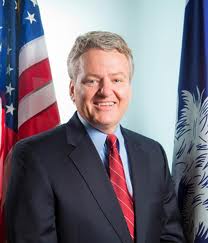
House Majority Leader Kenny Bingham, R-Lexington, said any savings at the state level would be shared with school districts.

“This bill is a starting point. No one should get hung up on any language in the bill,” said Bingham, a former Lexington 2 school board member. “Unless the districts buy in and take ownership of this, it will not happen. But I would think they would want this. It’s more local control. And there will be savings at both the state and local level. No one is interested in passing on a lot of costs to districts.”

Oh, we're not calling it profits anymore -- profits are bad -- we're calling it "savings" now. Savings is good. Right, judges?

Judges?

Oh, so it is profits, after all?

Yeah, you're right. Privatization is about profits.

Tuesday, February 28, 2012

Lawmakers propose robbing, then punishing, public employees

It's the same old song.

State Constitution empowers lawmakers to raise revenues necessary to fully fund the state's essential obligations and institutions. It doesn't give that power to the rest of us, only to the 170 men and women sitting in judgment in Columbia.

And when their decisions to rejigger how we invest retirement system funds, at precisely the moment of an economic downturn, results in a big drop in investment returns, what's their best proposal?

Rob more money from the pockets of poor, working-class public employees, then punish them further with cuts to retirement benefits.

This is not creative problem-solving; this is abrogation of responsibility. Deadbeat dad-ism. Absentee landlord-ism.

Here are the highlights identified by The State newspaper:

State workers to put more in, get less out

A look at the financial impact of proposed retirement changes

The average state employee would pay an extra $408 a year in retirement contributions.

State retirees, over the next 30 years, would receive $8 billion less in benefit payments.

State taxpayers, over the next 30 years, would pay $8.3 billion less into the retirement system.

It's a win-win-win, right? For everyone except those poor individuals who were willing to devote their careers to public employment, knowing that it meant lower wages but safe, secure retirement benefits that let us age in dignity.

Proposals like these drain the dignity from the process.

Proposed changes to the state retirement system immediately would cut $2.2 billion from its $13 billion deficit, according to a review of the plan by an independent accounting firm.

That is because, under the proposal, state workers’ retirement benefits would be based on five years of salary instead of three years of salary, a move that could lower benefits. And state workers could no longer include unused sick and vacation days to earn higher benefits.

The proposed changes mean that, over the next 30 years, state retirees would get $8 billion less in benefits than they would have under the current plan. And state taxpayers — required by law to contribute to the state retirement fund — would contribute $8.3 billion less than would have been required under the current plan.

House lawmakers plan to introduce a retirement bill this week, following months of negotiations with state workers, retirees and Gabriel Roeder Smith & Co., the consulting firm paid hundreds of thousands of dollars to advise lawmakers on the retirement system’s finances.

Here's the answer -- and it wouldn't have cost the state those "hundreds of thousands of dollars": Treat public employees with dignity and respect. Either pay them up front in much higher wages, or afford them the retirement security that comes from having reasonable retirement benefits they can count on.

“We are pushing hard to make sure we take corrective action now,” said House Majority Leader Rep. Kenny Bingham, R-Lexington. “If we can do it now, we’re really going to save the system a great amount of pain in years to come.”

Corrective action was necessary two decades ago, when lawmakers chose a path of atrophy: Paying less from state resources, investing less from state resources, cutting corporate taxes by loopholes and wholesale, demanding more from employees and offering less to them.

Or, if you want to look at things in the much longer view: Corrective action was necessary two generations ago, when lawmakers voted in 1954 to establish South Carolina as a "right-to-work-for-less" state, anchoring us forever to the old plantation and mill labor systems.

The S.C. State Employees Association opposes the changes for current employees, which would have the biggest impact on the deficit, according to the consultants’ review.

“We didn’t get into this scenario overnight, and we’re not going to get out of it overnight,” said Carlton Washington, the association’s executive director. “It would be, we think, punitive to punish employees who have provided the committed service over a number of years and built their portfolio around those expectations.”

Washington hit the nail on the head: South Carolina punishes its public employees -- just as it allows private employers to punish its workers -- for not being born into the state's aristocracy and ruling elite. Born powerless, we're kept powerless with a corporate boot on our collective neck.

In addition to benefit changes, state workers would have to pay an extra 1 percent from each paycheck into the retirement fund — an average increase of $408 a year. State Rep. Gilda Cobb-Hunter, D-Orangeburg and a member of the House retirement ad hoc study committee, said Monday she will push to have that increase phased in over two years to lessen the impact.

Why accept this proposal at all? Rather than offering to lessen the impact by phasing it in over two years, why not send those high-paid consultants back to the drawing board and asking them this question: How much revenue must be raised and appropriated to the retirement system in order to preserve -- and even strengthen and improve! -- retirement benefits while holding harmless our public employees who don't have the extra thousands of bucks to cover this gap.

Say it with me: Public employees are not responsible for this problem. State lawmakers had, have and will always have the power to do what's right.

But Bingham, who is also a member of the retirement committee, said the reason for the 1 percent increase is to “make sure the (retirement) system got an infusion immediately.”

The system needs an infusion immediately? Easy fix: Immediately eliminate all corporate tax loopholes and instruct a grand total of one staff person to direct all necessary additional corporate tax revenues directly to the retirement system. And when the system is solvent, apply the rest of the additional revenues directly to the base student cost under the Education Finance Act.

By my calculation, that should take care of the retirement system AND restore the base student cost to 2012-13 levels.

Problem solved. And I won't charge a penny for the consultation.

But, no, that leaves public employees whole. It affords them a little dignity. It helps them sleep a little more soundly at night. So it's absolutely unworkable. If slavery and mill culture taught us anything, it's that the ruling class must keep its workers hungry and anxious in order to get the most compliance. So, another quarter-turn to the thumbscrews.

If passed into law, the proposal means new employees would have to work 30 years, or reach age 65 with five years of service, in order to retire with benefits. And they would be ineligible for the TERI program, the controversial program that allows employees to retire and receive benefits while still working.

Current employees — who are eligible to receive retirement benefits after 28 years of service — would be exempted for both of those changes.

All of the changes would apply to members of the S.C. Retirement System, the largest of the state’s five pension systems, which includes state employees, local government employees and teachers.

Police officers, firefighters and other law enforcement officers have their own retirement system. They also would have to use an average of five years of salary to calculate their retirement benefits. And they would be banned from using unused sick or vacation days to determine the amount of their benefit checks.

But law enforcement officers — including new hires — still would be able to retire after 25 years of service.

Lawmakers would not escape unscathed, either.

Under the bill, a state lawmaker would have to give up his or her seat in the Legislature in order to receive retirement benefits. The proposal would end the practice of lawmakers retiring but remaining in office and replacing their $10,400-a-year salaries with much larger pension benefits — more than $30,000 a year, in some cases.

My heart bleeds for our lawmakers, forced to retire before they could collect their thirty grand a year for life. How will they live?

For advice, they might consult their public workers, who've been living on pittances for generations.

Monday, February 27, 2012

Our lawmakers giveth, and our lawmakers taketh away

Tears of joy may have erupted across South Carolina last week as a House committee approved a plan to raise state employees' and educators' salaries by two percent (and law enforcement officers' salaries by five percent), effective July 1. These folks have had their incomes frozen by the legislature for years, with some not seeing an increase since 2007.

But they've dried up pretty quickly as the rest of the proposal has come to light.

They would have to pay an extra 4.6 percent for their state health insurance and most likely will have to pay an extra 1 percent of their salaries into the state retirement fund to help make up for its $13 billion deficit.

Result: Net loss in salary.

That's right. Same work, one more year, more students in classes, fewer colleagues to share the burden, greater expectations, fewer resources for classroom instruction, no advocacy from the state's highest-ranking leaders, no rights to take collective action, and for all of this bounty, state employees and educators will take home less pay.

And this is called a good start.

For lawmakers, maybe. It's an election year. There's a budget surplus of nearly a billion dollars. So throwing public workers a bone looks good, feels good, and gets a little media coverage. It's a great day in South Carolina.

But not so great a start for public employees.

For years, Jo Ellen Dowdy, a high school math teacher in Lexington-Richland 5, considered her job as “secondary income” to her husband, a mortgage broker. But when her husband lost his job during the housing crash, their family of four had to depend on Dowdy’s teacher salary.

A raise would “mean a lot,” she said.

“We’ve made it through, but there were a lot of sacrifices to be made,” she said. “The salary should get to the point where a male can raise his family as a teacher instead of having to look at it as a second salary sort of profession.”

But Carlton Washington, executive director of the S.C. State Employee Association, called the pay increase “disappointing and short-sighted.”

For months, lawmakers have said state employees will have to make sacrifices to help resolve the $13 billion deficit in the state’s retirement fund.

“They have a billion dollars in new money this year, and 2 percent is what they recommend?” Washington said. “A 2 percent raise when employees are 20 percent behind inflation and a 4.5 (percent) increase in health insurance last year and a proposed increase in health insurance this year? That (salary) recommendation just does not represent shared sacrifice.”

The 2 percent increase for teachers would apply to all school district employees. It is possible because lawmakers agreed to give an extra $152 million to education in the state’s fiscal year that starts July 1, bringing the basic amount the state pays school systems for each student up to $2,012 from its current $1,880. Most of that money is dedicated for teacher salaries.

“Every single employee is important to the district. Everybody is needed in their role and everybody should be rewarded,” said state Rep. Kenny Bingham, R-Lexington. “With the retirement issues we are all dealing with, if we don’t provide them some remuneration, we are going to be in trouble.”

Update: We're not going to be in trouble. We're in trouble.

We've laid off educators. We've cut public employee rolls. We've furloughed. We've hiked health care premiums. We've done little else but give away massive corporate tax breaks.

The cupboard's bare; even the mice and cockroaches have vacated for Georgia and North Carolina. Now, Providence has defied our regressive tax policies and delivered an additional billion dollars to the kitchen, and the best our chefs can do is serve up some crumbs -- claiming that the meat and potatoes have to go to pay down old obligations.

Law enforcement issues also weighed on the committee.

The state Department of Public Safety had requested $4.2 million to hire an additional 56 officers, including 40 new state troopers. It did not get the money. Instead, its workers would get a 3 percent raise in addition to the 2 percent raise for all state employees, for a total of 5 percent. That raise also applies to Class 1 police officers at the Department of Natural Resources and the Department of Probation, Pardon and Parole Services.

“We are losing tenured officers to local governments who are now paying more,” said state Rep. Mike Pitts, R-Laurens, chairman of Ways and Means’ Law Enforcement subcommittee.

That extra 3 percent raise does not apply to officers at the State Law Enforcement Division. Instead, lawmakers gave SLED roughly $2.5 million to hire 45 new SLED agents.

“We had a discussion about that. The bottom line is ... I needed the agents to be able to do the jobs that SLED is supposed to be doing,” SLED Chief Mark Keel said, noting the additional raise only would have applied to the agency’s Class 1 police officers, not its full staff.

Here's a thought. How about restoring all the step increases in public employee compensation that have been frozen for the past two, three, four, five years -- all of them, not just two percent's worth of them. And how about addressing class size by bringing back educators to the classrooms?

And if we've lost so many law enforcement officers, how about slicing off a big chunk of revenue to bring back those folks, too?

What? All of that will mean raising revenues on South Carolina's wealthiest? Assessing taxes on fair market value for those mansions on the golf courses? Maybe even levying a millionaire's tax? A luxury tax?

Well, if that's all it takes, what's the hold-up?

What a blessing it is that God gave South Carolina so many blessed entrepreneurs and wealthy folks who can afford to shed a little excess change to help the rest of us. How godly of them to exhibit the generosity. And how blessed we would be to have lawmakers who take seriously their charges to South Carolinians.

Public employees, I guarantee, would settle for only sufficient blessings to have a little money in their pockets at the end of the month, so maybe they could save a little bit, too. They don't need the mansions of gold and titanic yachts and Humvees; I suspect they'd be happy with finishing out their mortgages, knowing their health care is safe and having a little retirement security.

Media: Romney kicks "toxic" Haley to the curb

Do you reckon this means Governor Nikki Haley's chances of joining the Romney ticket as a vice presidential nominee are down the drain? This is depressing; I was looking forward to the discussion of Lieutenant Governor Ken Ard's succession.

For the two weeks leading up to January's S.C. Republican primary, presumptive nominee Mitt Romney and S.C. Gov. Nikki Haley were seemingly inseparable.

They appeared together at events in Romney's adopted home state of New Hampshire, as well as multiple events across the Palmetto State: she was campaigning with her husband after her endorsment in mid-December, she was on the stage in Charleston when former VP candidate John McCain mistakenly called Romney by the name Obama and she repeated the mistake herself on her birthday, the day before the primary at a Greenville event.

But when Romney, leading in the state's polls throughout January until four days before the Jan. 21 vote, took the stage that night to congratulate former House Speaker Newt Gingrich on his victory — his only to this point — Haley was nowhere to be seen, instead staying home to celebrate her 40th birthday with her family.

I noticed that too! But I assumed that it was Haley's decision, that she didn't want to be seen with the loser and have those indelible images posted for all eternity on the internet, like the shots of her with ol' Sarah Palin.

So it was really Romney's choice?

And she's been absent ever since.

Instead of stumping for Romney through other important Southern states, where her name recognition would be high, Haley has stayed at home while heavy campaigning has taken place in Florida, Georgia and Virginia. Other prominent national Republicans — including Virginia Gov. Bob McDonnell and New Jersey Gov. Chris Christie — have taken her place.

Haley, through her spokesman Rob Godfrey, said that she remains in contact with the Romney campaign and plans to continue campaigning for Romney.

Remains in contact. Have you spent any time in our criminal courts recently? The dockets are full of cases of men or women trying to "remain in contact" with their former boyfriends or girlfriends after some acrimony. Judges call that harrassment or stalking, and sometimes they issue restraining orders against it. Is Her Man Godfrey trying to say that Haley is having difficulty giving up on that relationship? Our governor?

The governor's office also points to local responsibilities as the main reason she has been absent from any Romney campaign stops for the past six weeks.

News flash: There were plenty of local responsibilities to hold the governor's attention during those two long weeks in arctic New Hampshire, and during those ten long days that Haley spent escorting Mr. Inevitable from Greenville to Charleston. Those local responsibilities weren't enough to tear her away from her political meal ticket then, so why now, if it isn't that Mr. Inevitable has declared her Ms. Unnecessary?

"South Carolina is on the cusp of passing the largest government restructuring bill in two decades — that, our budget, and economic development is where the Governor's focus has been since the South Carolina presidential primary," Godfrey said in a statement.

Is that it? We need her more than Romney does? Forgive the chuckling in the background, but I somewhat doubt that. If the past decade has demonstrated one thing to the kiddies in South Carolina, it's that we're perfectly capable of running things without an effective governor, or his or her presence in Columbia. Uh, does the Appalachian Trail ring a bell?

We're on "the cusp," he says. The cusp. Such words. How about "the precipice"?

Comparable conflicts, like a pair of controversial abortion bills in Virginia and a gay marriage debate in New Jersey, haven't kept McDonnell and Christie off the trail, but Haley's office insists she will still play a role in the campaign.

"We're in constant contact with the Romney campaign," Godfrey said, "the governor intends to continue to campaign for him both before and after he's the Republican nominee, and her belief that he is the right person to occupy the White House is unwavering."

Uh-oh. We're veering into "Fatal Attraction" territory here: "I won't be ignored, Dan -- er, Mitt!"

Your Honor, what I'm doing is not harrassment or stalking. It's just that I know deep down in my heart that we're right for each other, and I'm willing to be patient until he realizes it too, but I have to keep letting him know that I'm here, so he doesn't forget what we once had -- and what we're destined to have again, forever.

Romney's campaign office did not return multiple phone calls and emails asking for plans to use Haley moving forward. And former S.C. House Speaker David Wilkins, another prominent Romney supporter, declined to comment on Haley's apparent lack of campaign involvement.

Ooh, that has to sting. Former House Speaker David Wilkins won't comment on Haley's status in the Romney campaign? Former Ambassador to Canada Wilkins, who has former President George W. Bush on speed dial? He's still in, but she's out?

College of Charleston Political Science Professor Kendra Stewart said the reason Haley has disappeared from the campaign trail may have to do with her novelty wearing off.

"There was initially a lot of interest in her," Stewart said. "She was new, a woman who was able to capture the top elected office in South Carolina, but a lot of that has died down as the national party tries to prop up their candidates."

This sounds an awful lot like an assessment of the gubernatorial campaign of 2010. Haley was a novelty, there was initially a lot of interest, she got a lot of attention, then she won office and, whoops, South Carolinians got a big case of buyer's remorse. Conservative temple priests like John Rainey start asking uncomfortable questions. Former employers start telling inconvenient truths. Angry, double-crossed lawmakers reveal backroom deal-cutting. Facebook friends post barbed comments and get unfriended. It's a mess.

What's shocking, really, is that Romney wanted to swim in that tainted pool at all.

Stewart said that Haley doesn't have as much in the way of leadership experience as some of the other big names lining up behind candidates on the campaign trail, and that is a potential reason she has fallen out of the spotlight now that the race has moved on from South Carolina.

"The other names popping up tend to have lots more leadership experience because that's one area where (Pres. Barack) Obama is polling the weakest, so they are looking for people with a lot more leadership experience," Stewart said. "They're looking for someone who can beat Obama in that area."

Oh, the unkindest cut of all! A comparison of inexperience between former U.S. Senator Barack Obama and Haley! Yikes. Medic!

The only thing worse than that would be to craft a reference to our governor using some Britney Spears lyrics!

At least one S.C. Democrat says the reason Haley is no longer at Romney's side is obvious.

“She’s absolutely toxic,” Democratic strategist Tyler Jones. “[The primary] exposed her. She’s the second most unpopular governor in the South and the national media didn’t realize that until they got into South Carolina.”

She's toxic!

Can anything be worse?

Jones said Haley’s fluctuating national reputation mimicked that of another female governor.

“The more people get to know Nikki Haley, the less they like her,” Jones said. “That’s sort of the same with Mitt Romney and Sarah Palin.”

Nooo, not Palin!

“You will not see Nikki Haley on the same stage as Mitt Romney again this primary season,” Jones added. “She might be able to raise money behind closed doors but the Romney campaign will not allow her to take a role in the campaign if he has any desire to win.”

How the mighty have fallen.

Stewart at the College of Charleston, meanwhile, sees some truth to Jones' assessment of Haley.

"Her endorsement of Romney didn't carry much weight with South Carolina voters," Stewart said. "That is indicative of her standing with South Carolina voters."

"She's not that popular at home now."

Stewart said Haley is making some of the mistakes that her predecessor Gov. Mark Sanford made in alienating legislators in the General Assembly. While Haley can point to the government restructuring bill, if it passes, as a win, she has burned many bridges already in the S.C. House and Senate.

"It's hard to rise any higher nationally if you can't get support at home," Stewart said. "And she's not making a lot of friends in the legislature."

Stewart said Haley has some popular ideas, but she has yet to be able to convert them into policies. She said people in the state are also getting tired Haley consistently turning down federal money available to the state, and her apparent refusal to listen to anyone who does not agree with her, and points to a recent Post and Courier article about Haley deleting Facebook comments that were critical of her.

"If she's not listening to anyone, that could hurt her re-election chances," Stewart said.

Governor, now might be the time to buck up, admit some neglect and misplaced priorities, and get on board behind South Carolina's 700,000 public schoolchildren. They could use a governor in their corner right now, because they haven't had one there in a long time.

Thursday, July 14, 2011

Hypocrisy defined, denied by Haley on ETV services

In her January address to the General Assembly, Governor Nikki Haley described her desire to effectively privatize South Carolina Educational Television. When the opportunity arose, she sacked the whole SCETV Board of Directors and replaced it with a new board of her acolytes, without regard to experience or knowledge of ETV's mission, history and services. Later in the legislative session, she apparently negotiated a deal with Rep. Kenny Bingham to see her privatization scheme implemented, then vetoed ETV's public funding altogether. Had the legislature not overridden her veto, ETV would have been a shell of its former self, no longer a public good.

All of which makes this item from the Post & Courier of Charleston special:

Gov. Nikki Haley wanted the state to nix funding for ETV, but that hasn't stopped her from using the station's services.

ETV provided lighting for the governor's television interviews Monday, despite the fact that Haley vetoed funding for the public educational broadcaster. Lawmakers later overrode the veto.

One imagines a soused lout, after beating a bony dog, instructing the poor animal to come and show affection. Or a vicious overseer, having berated a slave, demanding happy subservience. The malevolent parent requires tribute after lashing out at an child. The metaphors continue, all illustrating hypocrisy, meanness, arrogance.

"We have never said that ETV is not a good service to have," Haley said. "What we are saying is, if we use ETV they should bill us. We should pay them. To give them $10 million on a line item just because is wrong. To give them payment for services rendered is the way that we should have them in state government. That's what we fought for from the beginning. That's what we will continue to fight for."

So, did the governor's office pay for the ETV crew?

"I think they should be very happy," Haley responded. "It looks like they got $10 million this year, so once again we will go back to watching them get a lot of money and not necessarily know the services that they give."

Notice how Her Excellency framed the issue so as to beg the question, then dodged that question.

Her inconsistencies draw attention.

S.C. Democratic Party Chairman Dick Harpootlian said the action was typical Haley.

"It suits Nikki Haley to say one thing and do something else," he said.

Thursday, June 30, 2011

Will Haley's book feature a chapter on veto overrides?

Really, a book?

Her Excellency, Governor Nikki Haley, has been in office slightly more than five months.

In that time, she has booted the state university's largest benefactor in history from the board of trustees and replaced her with a campaign contributor. See Moore, Darla.
She fired the state's popular and effective retirement system director and quickly named a replacement without notifying key officers. See Boykin, Peggy.

She has presided over a rise in the state's unemployment rate, seeing it return to double digits. See Job Creation, Lack of.

Though millions of South Carolinians, with jobs and without, stretch the weekly groceries bill with ground beef and Hamburger Helper, she has lived well on the public grace, enjoying "menus with Peruvian squid tubes, rabbit loin, shiitake mushrooms and other exotic ingredients," plus "small amounts of Fresh Market Chilean sea bass at $25.99 a pound and Yellowfin tuna at $21.99 a pound, and a number of Publix sushi platters," as well as spending public funds "to buy a Riedel wine decanter and Riedel cabernet/merlot wine glasses." See "Let Them Eat Cake."

She has offended lawmakers in both parties with petty slights, withholding invitations to a Governors Mansion from some, turning another away at the gate. See Brown, Boyd; also Howard, Leon; also "Petulance and Pettiness"; also Not the People's House.

She injected herself gracelessly -- and has infamously sought to drag national candidates -- into a dispute between a federal agency and a corporate campaign contributor operating in South Carolina. See Boeing.

She has fueled a well-publicized feud with another elected executive officer, declaring him "irrelevant" to the state's official business. See Loftis, Curtis.

She bungled an agreement made by her predecessor's economic development team with one of the world's largest companies, who had begun construction on a location in South Carolina but shut down and withdrew when she engaged in a foolish game of chicken over tax breaks. See Amazon.

After campaigning on a platform of "transparency," she has conducted closed-door meetings with national bond-rating agencies and shut the state's retirees out of discussions about their retirement system. See Griswold, Sam.
She embarrassed the state by ignoring the President of the United States during a briefing of governors in the State Dining Room of the White House, and checking email on her iPad instead. See Reuters Photographer, Caught by a.

She provoked legal action from the President Pro Tem of the state Senate by issuing an executive order in contravention of constitutional powers and state law, losing the fight before the state Supreme Court. See McConnell, Glenn. See also Supreme Court.

She earned a stunning rebuke from the full legislature by issuing 35 vetoes and having all but nine overridden, just as quickly and spectacularly as were the vetoes of her predecessor, and garnered an especially raw accusation of double-dealing and dishonesty from a lawmaker from her own home legislative delegation. See Bingham, Kenny.

And she bragged, oblivious, to a small audience of fans in Florence this spring that she hadn't made any mistakes while in office. See Hubris.

All the while, apparently, Her Excellency has been writing a book, no doubt expounding on the highest principles of governance and her nascent, derivative political philosophy. (See Sanford, Mark.)

S.C. Gov. Nikki Haley has a book deal.

Sentinel, a conservative imprint of Penguin Group (USA), said Wednesday that Haley’s “Can’t is Not an Option” will come out in January.

Haley, a Republican and Tea Party favorite, was elected last year. At 39, she is the country’s youngest governor and only the second Indian-American governor.

In an interview in March, Haley said writing had been “therapeutic” and that she would cover everything from growing up in rural South Carolina to her contentious 2010 campaign, when she faced — and denied — allegations of infidelity.

Haley said she was not planning a run for national office. Her literary representative, Washington attorney Robert Barnett, has negotiated deals for Presidents Barack Obama, George W. Bush and Bill Clinton.

Notice the names that her "literary representative" has aided in the past: Barack Obama, George W. Bush and Bill Clinton, all presidents of the United States, including two two-term presidents. What is it that governor-for-five-months Haley has to offer that compares with these political giants? A Newsweek magazine cover?

The title is particularly trite: "Can't is Not an Option." Here's what "cant" is: "cant" is "empty, uncritical thought or talk."

"Cant" is also the "jargon of a group, often implying its use to exclude or mislead people outside the group."

"Cant" is also "insincere, especially conventional expressions of enthusiasm for high ideals, goodness, or piety."

Yes, I know. She's using the word "can't" as a contraction for "cannot," as in "Haley can't play well with others" or "Her Excellency can't understand why people won't just do as she instructs them."

Here's a fun project for readers: What do you imagine will be the chapter titles of Haley's book?
Example: "Voters Would Soon Learn What Hit Them, Hard"

Here's another one: What do you imagine would comprise Haley's top ten list of governing principles?
Example: Reward your campaign contributors early and well.

Or another: What should be the subtitle of Haley's book?
Example: "Can't is Not an Option: If You Can Read This, We're Spending Too Much on Education"