Showing posts with label Anderson Independent Mail. Show all posts

Monday, April 23, 2012

Mills helped define state's economy, history

This item from the Anderson Independent-Mail, by reporter Jennifer Crossley Howard, is as fine a requiem for South Carolina's used mills and mill workers as any I've seen, and it deserves an audience across South Carolina and beyond our borders.

J.L. Gaillard uses three words to explain why he lived 90 years on a mill hill. He leans back in his armchair, widens his eyes and smiles.

“I was captured,” he says.

He worked 39 of those years for Courtenay Manufacturing Co. in Newry, near Seneca, first picking up quills that fell from looms in 1936. He was 16 years old.

Gaillard made $12 a week then. When the plant closed in 1975 he had worked his way into management, but by then life at textile mills had changed forever in the South. Car manufacturing plants culled mill workers with promises of higher wages and better working conditions. Cotton fabric production moved to Asia and Mexico, where it remains.

Many mills like Courtenay shuttered. Thousands of jobs went away, leaving shattered windows and abandoned brick behemoths that had once knit communities together. Simple cotton mills have long been extinct in America, but their heartbreaking stories echo through the Upstate.

The four-story Newry Mill, where Gaillard and hundreds of others toiled, sits sunken and dilapidated at the edge of its mill village, hard to see behind overgrown trees and weeds. Faded graffiti is tattooed inside its brick walls and trash is scattered on the floor where 635 looms once stood. If the building were a person, its head would hang low.

In their heyday, mill villages like the one in Newry contained post offices, grocery stores, churches and schools.

“It was a wonderful place,” said Gaillard, who is 92. “The neighbors in 110 houses had commonality. You didn’t have a rich man here and a poor man there. You had all common attitude and philosophy.”

If a man was born into a mill family, there was an obligation to uphold.

“You’re sort of captured into an experience,” Gaillard said. “Daddy worked at the mill, granddaddy worked at the mill. That’s what you’re expected to do, go to work and help pay expenses. I did it because I didn’t know anything else to compare it with.”

When Gaillard started working at the Newry mill, it produced 36-inch cloth squares for diapers, dresses and men’s undershirts. The cloth left the mill and went to a bleachery, which applied patterns to it. Montgomery Ward or Sears, Roebuck bought the material. Gaillard moved from emptying quills to working in the cloth department. By 1957 he had married Mae Honicutt and had two children. Elvis Presley’s album “Loving You” hit No. 1 that year, and it was almost a century after the Civil War ended. But cotton was still king.

FARMING TO FACTORY

After the Civil War, northern textile owners quickly embraced the South for its mill landscape, moving production of transparent, coarse cloth to plants powered by the region’s rivers and streams.

Railroads, cotton and a thriving population attracted mill companies to the Upstate. By 1905, one in every six white South Carolinians lived in a textile community, and there were roughly 170 mills. In 1950 there were 1.3 million mill workers in the United States, according to the Bureau of Labor Statistics. By 1996 slightly more than half a million remained. As of September, the projected number of textile mill employees in South Carolina had fallen to 15,273.

In the eastern part of the state were mostly black sharecroppers. Mill owners reasoned that white farmers would need a new industry as farming became less productive, said Howard Bodenhorn, an economic historian at Clemson University.

The former Defore-Milliken plant on U.S. 123 piqued his interest in Upstate mills.

“You can actually see the old fountain in front of the mill and a whole mill village behind it,” he said, pointing out his office window in Sirrine Hall.

One of his students explored child labor in her term paper, and she found startling facts.

Some employees at the Pelzer Manufacturing Company began working when they were as young as 12 years old in the early 1900s, Bodenhorn said. But they were the exception; starting work at 14 or 15 was more common.

Others, like Gaillard, waited longer before they started rotating shifts.

When Newry workers ventured into Seneca, townspeople liked to call them lintheads because the cotton that flew from looms stuck to their clothes and hair.

Gaillard wore his cotton with pride.

“The president of the United States could call me a linthead,” he said. “I wouldn’t care.”

The Newry mill owned 700 or 800 acres where employees and their families worked and played. A bell in the mill tower rang at 9 p.m., when kids and adults were supposed to be indoors.

“It didn’t always work, but if you kept your mouth shut, nobody knew you were out,” Gaillard said.

Roaming the hilly woods around the plant, “We kids thought we owned the whole world,” he said. “We’d camp on it. The Boy Scouts would use it for stuff. It was a commonality that there will never be again.”

STILL GOING

Down the road from Clemson, after a left turn at a barbecue restaurant, is the La France community. An elementary school sits across from a one-story brick building that started as the oldest mill in Anderson County. La France Industries, once known as Pendleton Manufacturing Company, persevered when other mills closed, abandoning cotton fabric production to manufacture synthetic fabrics, including car upholstery.

Donald “Jose” Hubbard witnessed the mill’s fruitful years when workers and their families populated the mill hill where he has lived since 1966. Back then, workers didn’t need cars to get to work; they walked across a swinging bridge. Hubbard was 18 when he started working in the beaming department 48 years ago. He said he was asked to retire last September.

“I wanted to stay for 50 years so I could get that extra money, but they don’t want that,” he said.

His dogs Molly and Coco lounged on the porch of his red-trimmed house one afternoon while he hit golf balls in his generous front yard. Hubbard wears a baseball cap that says “I love my job. It’s the work I hate.” He points to neighboring houses and recites who lives there. He talks about how many years they worked at the mill and who has “gone to glory.”

Families with no connection to the mill are moving into the mostly faded mill village houses with porches. Some have two front doors so a husband and wife working different shifts didn’t wake each other. Financial records from 1947 show that Pendleton Manufacturing Company sold 74 houses for $102,500 to residents. Willie Mae Dacus paid $1,400 for her house at 10 Third St.

The mill first operated as Pendleton Manufacturing Company in 1838 and later made blankets for the Confederate Army. A new 675,000-square-foot building was constructed in the late ’60s, and by 2000 about 500 workers were there. Retirees estimate that there are about half as many workers now. La France Industries President Judson Boehmer declined to be interviewed, and the company would not allow Independent Mail reporters to tour the plant.

Former workers like Gary Padgett are surprised the mill is still open. He worked at La France for 15 years as a cloth doffer before he left to work at mills in North Carolina and Pennsylvania.

“If it lasts another year, it will be lucky,” Padgett said.

Hubbard made $1.25 an hour in 1964, and he earned $8.43 an hour when he left last year, he said. He is glad he got the chance to make an honest living. “They could have fired me two or three times,” he said.

‘NOW’S THEIR HEYDAY’

The Liberty Denim plant in Pickens County was not as lucky as La France.

The plant closed last December, two weeks before Christmas. It was a casualty of the times, said Jack Woodson, director of operations at Glen Raven Custom Fabrics.

Few denim plants exist in the United States, but Liberty Denim lasted longer than most. It had operated at 101 Mills Ave. since 2002, in the old Greenwood Mills building. The closing happened four months after Lewis Edward Smith II fell into a roller machine and died.

Along with the School District of Pickens County, Liberty Denim was one of the largest employers in town.

Machinery was removed from the mill in mid-March. Liberty Mayor Mike Sheriff said he dreaded the day that happened. “That’s when I knew it was over,” he said.

Ray Farley, executive director of Alliance Pickens, said he knew nothing about the mill’s closing negotiations except what he read in the Independent Mail.

Efforts to reach Liberty Denim representatives were unsuccessful.

There are only four companies left in the United States that produce denim cloth, said Mike Hubbard, vice president of the National Council of Textile Organizations. Mount Vernon Mills has a plant in Spartanburg, and Cone Denim is headquartered in Greensboro, N.C. Denim North America is in Columbus, Ga., and Plains Cotton Cooperative Association is in Littlefield, Texas.

Glen Raven Custom Fabrics in Anderson County was once a simple mill like Liberty Denim, but it became one of the first mills to make synthetic fabrics in the 1950s. It now produces materials for awnings, pillows and indoor and outdoor furniture. Its Anderson plant employs 700 people.

Like most industries, the mill weathered layoffs at the height of the economic crisis. There were 70 in 2009, according to the South Carolina Department of Commerce. Closings will claim every mill if they don’t change with the times, Woodson said.

“It’s not just a textile story; industry evolves,” he said.

A walk through the sprawling plant reveals a clean, modern space with more machines than humans, spinning earth-tone thread. Both Woodson and Randy Blackston, vice president of manufacturing at the Anderson plant, have textiles in their blood.

Woodson’s father worked at the Haynesworth mill on McDuffie Street in Anderson. He worked shifts among the five mills that stood blocks apart in the 1940s and 1950s. Blackston’s grandfather manufactured spinning needles.

Today, the Glen Raven plant’s air is purified, and a full-time nurse practitioner and occupational health nurse tend to any injuries. No one would dream of calling workers lintheads, because remnants from fabrics are not tolerated.

Because of such improvements, Blackston is convinced workers are living in the glory days of mills.

“I don’t think that was the heyday,” he said. “I think now’s their heyday.”

POUNDINGS IN COOLEEMEE

Lynn Rumley, mayor of Cooleemee, N.C., midway between Charlotte and Greensboro, preserves the memory of mill towns that she says embodied an all-American philosophy of hard work, faith in God and raising families.

“I know it’s not the American Revolution, but it’s an important part of history,” she said.

It’s a history that is taught in Cooleemee schools, thanks to her work with the Textile Heritage Center in her town. The first class learned about mills in 1997, and now their children study the curriculum.

Second graders learn about poundings. Families who move to Cooleemee are welcomed with a pound of sugar, flour and other non-perishables.

“We try to keep these traditions alive because they worked, Rumley said. “Despite the fact that they came from different places, they knew how to knit together a real neighborhood.”

Rumley says mill education is just as important to children as the three R’s. “Their pride in this place has been renewed by our heritage work,” she said.

BEGINNING OF THE END

Long before mills experienced competition from foreign labor, they faced another challenge.

A wave of Northern union organizers were met with strict intolerance in the Upstate. The Knights of Labor arrived in 1880 to recruit members. Mill owners retaliated by firing potential organizers and preventing them from getting jobs at other mills, according to information at the Anderson County Museum.

The resistance to organized labor in South Carolina continues more than 130 years later, but was solidified during the mill era, said Howard Bodenhorn, the economic historian from Clemson University.

“The mill owners clearly did not want unionized mills, and the politicians supported the mill owners, not the mill workers certainly in the 1930s and 1940s,” he said.

Union organizers threatened unity at mill villages, Gaillard said, dividing families and friends.

“It was a time I had never seen in my life, and a time I hope never to see again,” he said.

He was in high school in the 1930s when organizers came to the Newry mill village. He lost one friend “because my people were anti-union and his people were union. He got so he wouldn’t speak to me,” Gaillard said.

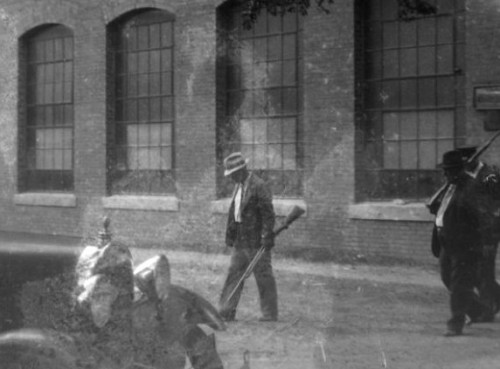
A landmark union standoff in 1934 left the blood of seven dead men on Honea Path streets. The shooting happened at the Chiquola Mill, and erupted out of the national General Textile Strike of 1934.

The end of World War II marked the beginning of a shrinking workforce for mills. Men came home after seeing a world of opportunity. Auto and energy companies promised higher pay and better working conditions.

In May 1975, the Newry mill closed, Abney Mills, which owned the Newry mill, was headquartered in Greenwood, and Gaillard had suspected the company had given up on it.

“I could tell by the upkeep; there was no money being spent,” he said.

By then, much of the production had moved overseas.

“I don’t know why they didn’t protect our local industry,” Gaillard said. “For the older people who lived it and experienced it, it’s sad. And it’s sadder that the federal government allowed it to happen.”

The mills provided their workers the path to a better life. Jerry Davis was an electrical apprentice at the Utica WestPoint Stevens plant in the 1970s. He left for another job and returned in the 1980s.

“I didn’t stay away long because they called me back on account of those 100-year-old telephone poles,” he said.

The Utica mill manufactured sheets and pillowcases.

Davis, who is 56, grew up on Goddard Avenue across from the old mill YMCA, which is now a grassy lot. The cedar shake YMCA was demolished when Davis was a boy in the 1960s.

He cried when it was torn down.

“We all sat on the bank in front of the house and watched a big crane knock it into a big pile of rubble,” Davis said.

The federal government did the same thing to textile jobs, he said, leaving a void of employment for the middle class.

“I don’t know why our government doesn’t understand that you’re always going to have a group of people who need a particular job they can learn and work day in and day out,” he said.

The federal government recently took a baby step toward keeping production in the United States. In February, President Obama said he would ask Congress to reward businesses that keep jobs home by reducing the top rate of the corporate tax code to 28 percent. That’s down 7 percent, and would favor manufacturers that set their maximum effective rate at 25 percent.

Such a proposal would have been handy 10 years ago, Bodenhorn said.

“The mills it’s going to help are those right on the cusp like Liberty Denim (was),” he said. “If you’re a mill that’s just completely out of date and not competitive, I can’t imagine the tax break would be big enough to overcome that kind of problem.”

Gaillard still has a house in Newry that he cannot walk in alone. He broke his hip a year and a half ago when he fell there, and he has lived at an assisted living home in Seneca ever since.

The biographies of former British Prime Minister Margaret Thatcher and denim pioneer Claude Levi-Strauss sit on his bookshelf, and a thick dictionary is open on the desk in his room. He started writing poetry long after his mill days ended. He explores the complexity of emotion that accompanies age.

“I try to stick to the real-life problems when I write,” Gaillard said.

Mill life provides inspiration.

The image of a South Carolina mill village has frayed over the years, but former workers like him readily share their war stories.

They are places where some residents answer the door holding shotguns, but welcome strangers interested in talking about the old mills.

Times got hard and then got harder, but Gaillard would do it all over again.

“If when I die God would give me a choice of where to be born and raised up as a kid” — he pauses and points firmly in the direction of the mill — “I’d choose Newry. We were happy.”

Re-enactments bring history to life

South Carolina has a colorful history, and I'm glad to see that re-enactments are being used to help teach our history to children in public schools, as in the case of the Battle of Anderson, as reported by the Anderson Independent-Mail.

Early Friday morning, the tents were set up and the camp fires were burning. The large bronze rifle was primed to fire, and the cell phones were all tucked away on the bus.

Friday was education day at the Honea Path base for this year’s Battle of Anderson re-enactment. Scores of elementary and middle school students showed up to see what life was like during the Civil War.

From two-man tents, the kind that often slept three or four soldiers, to elaborate walled tents where officers slept with all the comforts of home, the battlefield was readied to show students from all over the Upstate how soldiers and other citizens lived in the 1800s.

According to historians, the Battle of Anderson was fought in May 1865, three weeks after the end of the Civil War. Historians say a group of students from The Citadel happened upon a small group of Union soldiers. The skirmish, said to be the last to take place east of the Mississippi, resulted in no Confederate injuries and few Union casualties. Where the battle happened is debated among historians, but most agree that it was in Anderson County.

This year, on a parcel of land on S.C. 20 in Honea Path, nearly 150 years later, more than 100 people will gather to participate in a re-enactment of the battle.

Part of the goal of the event this weekend, organizers said, is to bring history to life for those who attend.

“Who won the war? The North. So the North got to write the history books,” said Berlin Owen, a re-enactor from Rosman, N.C. “This is our chance to teach children our side of the story.”

Students from Wright Elementary School in Honea Path-based Anderson School District 2, Iva Elementary in Iva-based Anderson School District 3, Varennes School of Communications and Technology in Anderson School District 5, and several home-schooling groups, were on hand Friday to see how soldiers lived, fought and died. Groups of students moved from station to station, listening to presenters talk about secession, life in camp, Civil War-era weapons, fighting on horseback and other aspects of life at the time of the Civil War.

“I liked the tents,” said Ellison Pruitt, 10, from Wright Elementary. “I think it would have been really hard to sleep in one like that. And it would have been really hard to live back then because it would be harder to get food.”

Owen said most people don’t know what a soldier’s life was like — that they had to scrounge for their own food; that more died from disease and exposure than being shot; and that they fought because they felt their homes were being invaded.

Erica Shoff, a fourth-grade teacher at Wright Elementary, said being able to see and smell and touch the artifacts brought by the re-enactors made history more real to the students. As part of South Carolina state educational standards, students learn about South Carolina history in third grade, the Civil War in fourth grade and reconstruction in fifth grade.

“It really brings it home for them,” Shoff said of the education day. “It really helps them connect with the people who lived it.”

I wonder if organizers are planning for a re-enactment of the Chiquola Mill Massacre of September 1934? That, too, would be a fine event to use in the teaching of our state's history to children.

In fact, because it's much more recent that the Battle of Anderson, it might make for fascinating discussion before and after the re-enactment, to learn if any children had relatives working in the Chiquola Mill during that period; or had relatives among the 100 "special deputies" appointed by the mayor and mill manager, Frank Beacham, on the morning of September 7; or had relatives among the seven who were shot and killed by those "special deputies" from the mill windows during that morning's strike.

The old mill is still standing, but it's not in good repair, so it's likely not a good place to tour. Still, children could stand on the street and observe the windows from which the shooters killed the striking workers.

And they could gather for lunch at the little park in Honea Path where a memorial was finally created 15 or so years ago.

There's nothing like a re-enactment to make history come to life for our children.

Friday, March 16, 2012

Anderson Independent Mail weighs in against vouchers

The headline tells the tale: "Here we go again."

Editors of the Anderson Independent Mail, hometown newspaper to Rep. Brian White, chairman of South Carolina's House Ways and Means Committee, have issued their position on the newest-and-unimproved version of the voucher-and-tax-deduction bill sure to arise in the next couple of weeks.

Funding private education with public money via tax credits or other means has been a divisive issue in South Carolina for almost a decade. It continues to rear its head in each legislative session, usually aided by the same lawmakers who bring it up every year. And each session, it fails.

The current session should end on that same note.

Elegant simplicity.

The latest version, sponsored by Rep. Brian White, R-Anderson, and Rep. Eric Bedingfield, R-Greenville, was advanced by Ways and Means by a vote of 16-8, the Associated Press reports. Sixty lawmakers have signed on as sponsors. Parents will be able to take a $4,000 tax deduction per child for tuition paid, $2,000 for home-school expenses and $1,000 for parents who send their children to a public school outside the district.

The proposal won’t come up for consideration until after the budget debate, White said, and then just in negotiations after the Senate passes its spending plan. But it’s all been said before. The biggest difference in this plan is merely an accounting change: tax deductions rather than tax credits.

Donors to new nonprofits that give scholarships to poor and disabled students can claim tax credits for those donations. Yet few students will be helped by parents’ ability to claim tax deductions if paying for school up front isn’t possible, or if their child fails to qualify for a scholarship to help the donors’ tax liability. The two highlights of the proposal add up to just one thing: less money for public schools.

Only thing missing is the reference to the American Legislative Exchange Council, the right-wing organization that incubates bad ideas and distributes them to state legislators in the form of "model" legislation.

It's like buying a term paper: All you have to do is change the title, the page numbers, maybe edit the footnotes, and slap one's own name at the top. Voila!

Over the years millions of dollars in out-of-state money rolled in — and will likely continue to roll in — to advance school choice via contributions to political campaigns.

It’s not about advancing education. Why should out-of-state donors care about South Carolina’s children? Apparently some lawmakers don’t; why expect a stranger to?

When funding for public education is diverted to private education, we all lose. Why is it so difficult for some lawmakers to grasp that an educated populace, regardless of whether the taxpayer has a child in the system, is vital to the state overall, both economically and with respect to business development?

Instead of looking for ways to take money from the public schools — after already sending our per-pupil spending to levels of more than a decade ago — we should be looking more closely at ways to help public-school students thrive. While that doesn’t mean more money is the answer, it insults us all when political motivations are disguised as being “for the children.”

White’s proposal is somewhat cheaper than past versions, according to the AP, but one glaring omission in his plan is there is no proposal on how to pay for it, nor how to make up the estimated $37 million reduction in state revenues in one year alone.

If the people funding all this legislative push to further damage public education ever deign to visit South Carolina, let’s be sure to show them the truth: overcrowded classrooms, demoralized teachers and thousands of students who are tacitly being told they’re not as important as they — and their parents — always hoped.

Thank you, editors, thank you.

One more thing and then we’ll descend from this familiar soapbox for the day. Democrats, reports The State newspaper, “argued that the legislation lacks accountability. Republicans countered that parents would hold the schools they choose accountable on their own.”

Unlike in public education, however, teachers and administrators in private schools don’t have to listen. And, despite any personal convictions about education, by law they don’t even have to care.

Friday, March 9, 2012

Report: State's graduation standards reflect definition of rigor

Just as few days after declaring that South Carolina's school standards were too low -- and blaming former Superintendents Inez Tenenbaum and Jim Rex for weakening them -- Superintendent Mick Zais is unfortunately unable to comment upon a new report that shows some of the state's high schools deliver quite rigorous curricula -- rooted in high standards and expectations.

Jay Ragley, Zais's press secretary, told the Independent Mail of Anderson that his boss "had not been supplied the report and was unable to comment on it yet." Hopefully the mail -- if not the Independent Mail -- will get to Columbia soon.

Meanwhile, tens of thousands of high school students and thousands of their instructors across South Carolina are learning and teaching according to rigorous standards, and they are certainly able to comment on it. This is the difference between being an educator and being a politician.

"While education experts often disagree on what truly constitutes 'rigor,' the definition put forth by the National High School Alliance succinctly captures the essence of the concept," the report says. "Rigor, according to the alliance, is shorthand for 'an educational experience that leads to a common outcome — that all students are well prepared for post-secondary education, career and civic life. Further it state that rigor is marked by a 'steadfast focus' on increasing achievement for all students through high-level content and instruction, and aligning high school requirements with college and work expectations."

The report by researcher Clifford Adelman says academic intensity can be seen in the requirements for graduation in a school. Adelman's report says academic intensity in high school predicts success in college more than grade-point average, test scores or class rank. In his study, the highest level of academic intensity was a transcript that included 3.75 or more units of English; 3.75 units of math, with the highest being calculus, pre-calculus or trigonometry; 2.5 units of science; more than 2 units of foreign languages; more than 2 units of history and social studies; more than 1 advanced placement course and no remedial classes in English or math.

That transcript closely resembles South Carolina's graduation requirements. In this state, students must have 4 units of English, 4 units of math, 3 units of science, 3 units of history and social studies and one unit of foreign language or career and technology education.

Isn't that something? The definition of "rigor" and "academic intensity" happens to include a catalog of coursework that "closely resembles" South Carolina's own graduation requirements.

I reckon our standards are pretty damn solid, after all, and that our superintendent will be issuing his apologies to the thousands of educators and students he offended with his callous political remarks of last month -- and in writing, since the offensive original column was in writing.

Interestingly, this new report says that South Carolina could offer more rigor to its curricula by doing several things -- "adding to their curricula advanced placement courses, dual credit courses, International Baccalaureate instruction, higher level math courses and early college instruction" -- that will cost a lot of money. Given that Zais has decried our standards and the state of our system, would he initiate a request for the additional funding necessary to implement these recommendations? You know, if his goal is to improve our standards and add more rigor to our school curricula.

That might be called putting one's money where one's mouth is.

Shall we hold our breath and wait for that request to come from the penthouse suite of the Rutledge Building?

Boosting its local readers' schools, the Independent Mail reports that all of the high schools in its area offer the courses recommended by the report.

All of the high schools in the Anderson, Oconee and Pickens area offer advanced placement courses. Many of the schools offer dual credit courses, as well. Student participation in those classes varies depending on the district. Iva-based Anderson School District 3 has the lowest student participation rate in AP classes with 8 percent while the School District of Oconee County has the highest with 24 percent.

"AP classes are rigorous and require success in appropriate prerequisites," said Tripp Dukes, assistant superintendent for instruction at District 5. "All students with the prerequisites and work ethic to handle those classes should be given the opportunity. To get underserved students in those classes begins by raising the expectations and rigor in the elementary and middle schools which we strive to do."

In Anderson School District 5, two new programs — one for high school level International Baccalaureate instruction at T.L. Hanna High School and Early College Academy at Westside High School — offer advanced instruction.

Good for the students and educators in Oconee, Anderson and Pickens counties. Perhaps the superintendent will send his first wave of apology notices to them.

Patte Barth, director of the National School Boards Association's Center for Public Education, said bringing academic rigor to high schools depended on the school.

"Are high schools rigorous enough? The answer is 'It depends,'" Barthe said. "High schools are doing a great job of increasing rigor and making students successful. But it is uneven. We're not suggesting any of the suggestions are the only answers, but they are some suggestions high schools can take to make their students better prepared for postsecondary education."

But Hannah Arnold with Crescent said it also depends on the student.

"I think it comes down to the student," she said. "It really depends on what courses the student chooses to take. Our high school course offerings are diverse. It just depends on the student to chose the more rigorous courses."

It always comes back to the student, certainly.

But it helps to have a supportive advocacy structure in the state capital, missing no opportunity to strengthen and improve a public school system that is clearly moving in the right direction, and that would benefit immensely from a restoration of investment in South Carolina's 700,000 public schoolchildren.

If this current Rutledge regime can't meet that need, maybe South Carolinians should raise our standards and elect a new one.

Monday, February 20, 2012

Corporations once helped, not hurt, public education

This is a great story that illustrates how corporate America once stood in partnership with public education and educators. If only to remind us of what that was like, this story should be shared far and wide.

Building construction student Frank Kay has worked on framing a building before. But the one he’s helping build on the Tri-County Technical College campus in Anderson is different.

Kay, 41, is proud of this building, because when it is finished, it will teach the local community something about what his ancestors went through to be educated. This one-room schoolhouse will be a replica of a Rosenwald school that was built for the local black community in the 1920s and 1930s.

“Anything to do with education and our heritage is good,” Kay said. “Maybe these younger kids will see what their ancestors went through to get an education. Maybe that will inspire them to go on and get an education. Because everybody needs an education these days.”

In this schoolhouse, people will see that those who went to class in a Rosenwald school made the most of natural light instead of using a lot of electricity. They did not have indoor plumbing. Books for the classroom were scarce, and often were worn and ragged after they were passed on from the local white schools.

There were 5,357 Rosenwald schools from Maryland to Texas, funded by Julius Rosenwald, the president of Sears, Roebuck and Co. and contributions from the local black communities. The schools were built between 1910 and 1932.

Of those 5,357 schools, 500 were in South Carolina. Nineteen of them were in Anderson County.

Three of them still stand in Anderson County.

That’s why this building means so much to Kay, and especially to those who learned about math, reading and writing in the Rosenwald schools.

“This was all we had,” said Genevieve Smith-Brown, who attended two of the Rosenwald schools in Anderson County.

As those schools fade from the local landscape, local historians, educators and community leaders are trying to pass on what the Rosenwald schools represented to a future generation.

A permanent exhibit, By the Book, on display at the Anderson County Museum details the history of the local Rosenwald schools.

Tri-County Tech has joined in a partnership with the Anderson County Museum to build the Rosenwald replica, using the college’s building construction technology students, said Tim Bowen, head of the college’s Anderson campus.

By the end of the year, the one-room school house will hopefully be open to the public for various educational programs and gatherings, Bowen said.

“This is a part of our history that is quickly slipping away,” Bowen said. “So the more we thought about it, the more this project made sense. It was about education, cultural and historical preservation and connecting this campus to the community we serve.”

An hourlong program about the history of the Rosenwald schools will be presented Tuesday at the Westside Community Center in Anderson.

It is the second year for the program, which hosted by the Anderson County Human Relations Council.

Bowen will speak about the Rosenwald project at the college. Anderson County Museum Curator Alison Hinman will speak about the significance of the Rosenwald schools and education to the local black community.

“We put this together to enlighten the community, and to show the challenges and struggles the black community went through to get any kind of education,” said Delores Green, Anderson County Human Relations Council president.

Green said her father, Lawrence Green, was a student at the Anderson County Training School in Pendleton, which was built before the Rosenwald funding but received a $1,400 grant from the Rosenwald program in 1921.

“He was one of nine children,” Green said. “Half of his siblings would go for half of the school year, and the other half would go to school the rest of the school year. That way, someone was always working in the fields.”

To Hinman, the dedication members of the black community had to sending their children to school, despite the difficulties and the primitive conditions of the schools well into the 1930s, is well worth remembering.

“I think there needs to be a balance of history,” Hinman said. “The Rosenwald schools were important for the black community. Most of our early history gives a passing glance of our African-American history. This is an attempt to balance that out. I don’t think you can tell the history of Anderson County without telling all of its history.”

To show how important education was to the black community, one can look to the Greeley Institute, the first private school for black students opened in the Anderson County area before 1899.

The school was built in Anderson, along South Fant Street, and was opened in June 1870.

“The attendance record was astounding,” Hinman said. “Education was a vital aspect of the African-American community. For the black community, education was the way they were going to prosper. Many families made huge sacrifices to make sure they kept their children in school.”

Given an opportunity to earn an education, they seized it. What an inspiration.

Monday, January 23, 2012

Anderson IM: We can't cut our way to education excellence

Editors of the Anderson Independent Mail wisely waited until the hordes cleared the field this week before issuing comment on Governor Nikki Haley's State of the State address, and I'm glad they did.

Through Saturday evening's primary returns, news of other sorts got washed away, and this is too great a concern to let go by unheard.

Their verdict on the the Haley speech? Not enough.

As is usually the case, there were no surprises from Gov. Nikki Haley in her state of the state address earlier this week.

It wasn’t a speech that evidenced much innovation or many plans for the future, but rather a congratulatory recap of the past year, singling out representatives of companies that have a presence or are adding a presence in our state. While many of the jobs won’t be fully realized until some years down the road, we would agree that it is a fine start.

We can’t help but admire her optimism. We hope, as we have always hoped of governors past and present, that her rosy view of our state, if not quite the case today, will be the case tomorrow. And we’ll be looking toward her to make her idea of South Carolina become the truth, that “our state is surging.”

Honestly, I still don't know what that means, that South Carolina is "surging." I see no signs of "surging."

noun
1.
a strong, wavelike, forward movement, rush, or sweep: the onward surge of an angry mob.
2.
a strong, swelling, wavelike volume or body of something: a billowing surge of smoke.
3.
the rolling swell of the sea.
4.
the swelling and rolling sea: The surge crashed against the rocky coast.
5.
a swelling wave; billow.

verb (used without object)
10.
(of a ship) to rise and fall, toss about, or move along on the waves: to surge at anchor.
11.
to rise, roll, move, or swell forward in or like waves: The sea surged against the shore. The crowd surged back and forth.
12.
to rise as if by a heaving or swelling force: Blood surged to his face.

Does Haley mean to suggest that South Carolinians are forming an angry mob, preparing to storm the Capitol? I might see that; the Occupy Columbia movement may have been on her mind. Or that South Carolina is billowing like smoke? Indeed, the return of the legislature to Columbia brings with it a high volume of hot air.

But what I think she meant is that a Haley-induced economic boom is just on the horizon. If that was her meaning -- the yet-unclear perception of something on the horizon -- she might better have used "mirage" rather than "surge." People under pressure or strain sometimes have perceptions that others do not; they may see a "mirage" and believe it is a "surge."

Still tens of thousands of unemployed South Carolinians and working poor see no mirage and no surge; they see unpaid bills and hungry children, and a calendar that tells them warm weather is still months away. They are under pressure and strain, but this is no mirage; this is reality.

The editors seem to agree:

Haley is enthusiastic about job creation in South Carolina and, again, we will look to her actions to make that a reality. But it’s still not “a great day in South Carolina,” no matter how our state office telephones are answered. We have high unemployment, a disregard for the value of public education at our top levels of government and not as much transparency as we were promised during her campaign. The recent controversy over her office destroying emails that it deemed not important is but one example.

The words that gave us the most pause, however, came early in her speech: “We believe all is possible with hard work. And our great hope lies in creating a better tomorrow for our children and our children’s children.”

How, pray tell, can that be accomplished if there are more cuts to public education coupled with more money for charter schools? A traditional public school has to educate every student that comes to its doors. Public schools cannot pick and choose. While this doesn’t cancel out the benefits of charters or excuse the failings of some public schools, the issue of how to improve our schools is much more complicated than it appears, even to the experts –– or the politicians.

Yes, pray tell, Governor. Little pitchers have big ears, and the state's children are straining to hear your wisdom on this subject, not to mention the state's educators in public schools. Opine, Governor. Orate. Bring the light.

You are governor to a state in pain. The whole of your citizens is not found on your campaign donor list, and those not found on your donor list can't be shut out of your view of the state just as you shut them out of the Mansion gates.

You may be champion of a small imperial class, but you are governor of four million, many of whom don't see or hear you addressing their needs. Not a single word of your text gave succor to the children of unemployed parents, to the children in South Carolina's rural counties and our Corridor of Shame. To be sure, the only children who have benefited from your rhetoric to date are your own, as they see their mother's lifetime earning potential as a Fox News contributor surpass all understanding.

The lack of mention of support for public education during the speech was painful and a direct hit, not just on the minority party but members of the majority party who have joined their colleagues across the aisle to repeatedly reject any notion of public money for private education.

How can we hope for a better future, not just for our children but for our state, without the strength of public education available to all with equal measure of excellence? Our state already took away the primary funding mechanism for public education. What will we do next to the detriment of our future leaders?

This is the very nature of a mirage: It dissolves as we draw nearer, just as the South Carolina of Haley's imagining fades with each passing day.

If a company is considering coming to our state or expanding operations in our state, it will be a strong public education system, one where that company’s employees will educate their children, where an educated workforce will be a given, that will help bring it here, not declines in state support for one of a state’s most vital responsibilities.

In this regard, Haley enjoys the bequest of the old Gressette Commission, which delayed implementation of integration long enough for various segregation academies to spring up across the land. The intent was not, has never been, to provide quality public education to all children; the intent has always been to provide quality education to the select, and that, if necessary, through new creations such as virtually exclusive charter schools, or through publicly-subsidized private schools.

It may as well be in our state Constitution: Children of the elite shall have their opportunities; children of the rest shall have what is minimally adequate, as the courts have affirmed. In this, Haley is merely adding herself to long list of malignant leaders.

Haley spoke at length about Boeing, about “the excitement that swept across South Carolina back in the fall of 2009,” not even pausing to mention that she had no part in the company’s investment — and promise of jobs — in North Charleston. It was the administration of Gov. Mark Sanford that welcomed Boeing to South Carolina, although Haley’s speech said that she and Commerce Secretary Bobby Hitt came into office a year ago and “found an economic development community … that was fractured.” It must have been doing something right.

It is the hubris of the young to assume that the splendor of the world began with their own birth, and that what existed before them was squalid.

It is the same hubris that leads to their downfall. As high as Icarus flew, so flies our governor, away from reality on the ground, but gravity and its disappointments come soon enough.

Haley is accurate, however, about our state’s natural beauty, and we were pleased that she mentioned the Upstate when speaking of “the tidal creeks of Beaufort to the shores of Lake Keowee” as examples that make us the “envy of the nation.” She recognizes the importance of tourism to our state and we hope that she will remember its importance in budget matters. And we appreciate that she also recognizes that while new business is always welcome, existing businesses need our support as well.

Yet we remember that last year she proposed cutting the budget for training through our technical college system (for some of those same new and existing businesses), while in this year’s state of the state, she went out of her way to compliment its efforts and results.

Finally, her fiscal remarks were expected and unremarkable. She prefers to return potential overages to taxpayers (averaging less than $90) rather than supporting much-needed improvements in our infrastructure, in repairing roads and bridges that have for too long been allowed to deteriorate. Both economic development and the furtherance of our standing as a tourist destination would benefit.

We’ll talk more about her executive budget and the General Assembly’s plans in the days to come. But for now, while we weren’t particularly inspired by her speech, we do see it as an opportunity to hold her to her public promises, especially this one: “I will not rest until we’ve created a climate in which every citizen of this state who wants a job, has a job.”

Sadly, we all know what promises were made for.