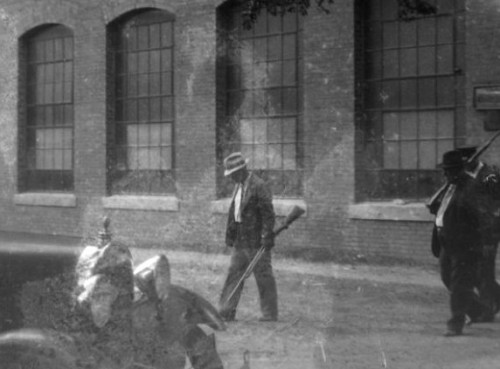
If this weren't a free screening -- if admission cost $30 a head -- I'd still recommend that anyone within driving distance of Columbia come to Conundrum next Tuesday, January 24, to watch "The Uprising of '34." Conundrum is at 625 Meeting Street, West Columbia, and the film begins at 7 p.m.
I've referred to "The Uprising of '34" before, but it bears repeating and deserves, particularly in South Carolina, particularly at the moment when the rights and dignity of working men and women are being ritually denigrated again, all the attention and promotion it can garner.
Yes, Tuesday is the night of President Barack Obama's State of the Union Address, and it will be important to watch and hear the president's speech at the beginning of this election year. But here's a flash: CNN, and probably other cable channels, will re-run the speech later the same night.
A screening of "The Uprising of '34" isn't likely to happen again soon. In fact, the film isn't readily available for purchase on DVD -- I've tried, even calling the production company that now owns the rights to it -- and only a two or three college libraries in South Carolina have copies in their collections.
So come to West Columbia, watch this film for free, then go home and watch the State of the Union. If Rep. Joe Wilson shows out again at this one, you can be sure we'll see his foolishness replayed over and over again.
Simply put, this film is about us.
On Labor Day 1934, hundreds of thousands of Southern cotton mill workers walked off the job in what would become the largest single-industry strike in the history of the United States. But until the making of this film, the General Textile Strike and its violent suppression—seven strikers were killed—were largely unknown.
Filmmakers George Stoney, Judith Helfand, and Susanne Rostock, spent nearly six years tracking down primary source materials and surviving strikers in the South not only to reconstruct the historic event but also to examine its inconceivable disappearance from the collective conscience. Through a combination of rare archival footage and contemporary interviews, their film probes the working conditions that led to the strike, the events of the strike itself, and the violence and intimidation whose lasting legacy could be felt even 60 years later.
For many of the interviewees, The Uprising of ‘34 provided their first opportunity to speak about the long-suppressed events—demonstrating once again the power of documentary film to recover the collective history so vital to our democracy.
If you're no more than one or two generations removed from the hardscrabble, hand-to-mouth existences of South Carolina's working poor -- or, just as likely, if that still describes your situation -- you'll recognize the people and words in this film. And if you have a beating heart and bleed red, this film is likely to evoke strong emotions in you.
If that's enough to convince you, by all means stop reading here and go on to West Columbia on Tuesday. If you need more information, here's some more from documentary film researcher David Whiteman:
The Uprising of ’34 originated from a request made to Stoney from the “Consortium on the General Textile Strike of 1934,” a loose association of scholars, organizers, and union activists who were interested in labor history and who wanted a film produced on the 1934 textile strike. The strike began on Labor Day, involving almost 500,000 workers in twenty-one states from Maine to Alabama, and ended in defeat three weeks later.
The members of the Consortium knew the strike was important in Southern labor history but also knew that few people today had heard of it, much less of its violent suppression and continuing legacy.
...
Labor history has long been suppressed in Southern U.S. culture. To counter the loss of political memory, the film explores the by-now unfamiliar events of 1934 by combining rare archival footage and dozens of contemporary interviews. The strike itself had lasted three weeks, involving hundreds of thousands of cotton mill workers, who were challenging the working conditions in the mills. The film documents the events of the strike but more importantly probes the strike’s incredible disappearance from our historical conscience, especially in the communities in which major events took place.
In the process of developing the project, the filmmakers found themselves involved in a fascinating set of interactions with Southern communities. Armed with videotape of original Fox Movietone newsreel footage, primarily unedited outtakes of the strike, Stoney and Helfand visited some of the strike’s key locations, hoping to refresh memories and generate publicity to gather interviewees for the film.

Some of what they unearthed -- the condescension of mill owners and their modern-day heirs, the commentary about the role of church leaders and what passed for law enforcement in these poor communities, and the outright greed and malice that led to the massacre at Honea Path -- will still burn your nerves, nearly 80 years after the event.
"As documentary filmmakers, we found ourselves in the position of interlocutors–bringing the physical evidence of unionism into the Piedmont towns where it had been forged and then forgotten. The trunk of our rental car was weighed down with proof: cardboard file cabinets, organized by mill and by state, filled with copies of letters from mill workers to the Roosevelt administration demanding that their rights as workers and citizens be protected."
These letters are heartbreaking -- and voluminous. If you're descended from mill workers, your ancestors may have written letters like them.
"We also brought a file full of the only comprehensive collection of photos of the 1934 strike, … For many strike veterans, our visit was the first time that they had seen these pictures and letters."
Throughout the production process, the filmmakers asked a wide variety of individuals and organizations to become involved. They especially encouraged the cooperation of many individual citizens, particularly former union members and their descendants from small textile communities throughout the Southeastern United States. The producers hoped that this extensive engagement of people in shaping the film’s content would not only improve the film but also give everyone involved greater incentive to use it. Even newspaper reporters were invited to cover the production process. Not only did that presumably increase reporters’ interest in covering the finished film, but newspaper stories also played a role in leading more former mill workers to come forward to speak about the events of 1934.
...
For some the experience was too painful. As one woman says at the beginning of the film “I ain't got no more to say into it. I've been trying to forget about all of that, and this is just bringing it all back up.”

The film's content was so controversial that modern-day equivalents of those mill owners -- the corporate titans ruling a system that still draws massive profits from subjugated workers --
succeeded in blocking broadcast of the film in South Carolina in 1995.
In his account of Honea Path in 1934 and today in the book "Dixie Rising," [author Peter] Applebome notes how six decades after the strike South Carolina public television refused to air The Uprising of ’34 — in part due to opposition from Carlos Ghosn’s former company Michelin, which has a plant in South Carolina.
He also interviewed Fred T. Moore, a veteran former state legislator who edited the Honea Path Chronicle from 1945 to 1981. Moore boasted of never making “a single mention” of the strike “in all the years I ran the paper, and I don’t see why anyone would mention it now. There are too many bad memories, too many people it could hurt. And there’s not a lot of unions around here and there’s not gonna be."
Hallmarks of totalitarianism, alive and well in the heart of a flag-draped democracy.
Indeed, SCETV refused to air it when the film premiered on public television -- nationwide -- in September 1995. It would be another two or three years before South Carolinians could see the film aired on television, and then only once, at 11:30 p.m.,
thanks to private fundraising to buy television time.
Since South Carolina ETV's decision nearly three years ago not to air "Uprising," supporters and opponents of its airing acknowledge the program has probably received more attention in South Carolina and across the South than it would have had the 90-minute documentary been aired in the late hours of the night when even fewer channels are set on public television.
"It continues to be a very hot topic," said Kathy Gardner-Jones, spokeswomen for South Carolina ETV, acknowledging that public response to the decision not to air the program was decidedly against the station's position.
Many public stations outside South Carolina, except WTVI, the public station in Charlotte, North Carolina, have aired the program to widespread public acceptance. There have been a number of community viewings on college campuses, at local theaters, at the state museum. One group even raised money to air the film on a commercial station in Charlotte, after the public station refused.
...
The story behind the story is an intriguing one that also sheds new light on the politics of programming in public television.
...
The film was eventually completed and picked up by "Point of View," a New York-based service that packages documentaries that oft times visit controversial subjects.
Most public television networks, like South Carolina ETV, purchase rights to air "Point of View." With the purchase, they have the option to air or not air any or all selections for the season.
...
By the time, "Uprising" was in the "Point of View" lineup, South Carolina ETV had canceled its "Point of View" contract. South Carolina ETV was offered an opportunity to take "Uprising" program separately, but after heated internal debate, refused that offer citing its decision not to take "Point of View" programming.
"It was a very controversial decision and there was a difference of opinion within the station,' Gardner-Jones said. "The argument was that we don't air the series and we aren't going to pull "Uprising" out and put it in. If we start cherry-picking then you get other groups mad be-cause we didn't air their particular program.
"It's just an editorial decision," she said. "It was their belief (the program department), that this film didn't represent overall community wishes of what they wanted to see. There was a lot of soul searching here and there still is. This was not a unanimous decision at all."
The station's decision had the effect of barring the film from being shown on any of the state's four regional public television stations.
...
Despite refusing to air "Uprising," SC-ETV did agree to allow other stations in its coverage area to air it. Under standard PBS procedures, stations have the exclusive right to air a program four times in four years.
Outrage in Columbia and the Greenville-Spartanburg area generated enough donations for a group in favor of airing to purchase an 11:30 p.m., Sunday slot on the NBC-TV affiliate in Spartanburg.
When it was finally scheduled to air in Spartanburg, a correspondent wrote for the Herald-Journal there:
It looks like Upstate residents finally will be able to see an interesting public television documentary about a little-known incident in textile industry history. But they won't see it on South Carolina Educational Television. The program's producers are raising money to have the film shown on WYFF-TV.
SCETV has consistently failed to air this program, "The Uprising of '34." Public television viewers across the nation have seen the program, and SCETV even bought the rights to air the program here as part of the "P.O.V." or point of view series. The film tells the story of mill villages and textile plants. It gives the viewer a look at life in many areas of South Carolina 60 years ago. Then it focuses on how Southern textile workers started a nationwide strike and how that strike eventually included half a million workers. Then it shows how the strike turned violent in South Carolina, where seven workers were shot to death in Honea Path.
Interesting fare for South Carolina viewers, wouldn't you think?
Certainly it would fall into the type of thing a network would air if it aims to "teach and inspire" South Carolinians. But SCETV consistently has refused to air the documentary. In June, SCETV officials said it simply had been left off the schedule and might air in the fall. In September, they said they had no plans to run it. Now, they have given up the rights to it. Kathy Gardner-Jones, SCETV vice president of communications, says "The Uprising of '34" is not part of one of ETV's main series, and its 90-minute length makes it difficult to fit into the schedule. She says the plan to show it on WYFF is a "nice compromise."
It's not. It's a dismal failure by SCETV to maintain public faith and to fulfill its mission. "There's no conspiracy here," Gardner-Jones says. ETV officials want us to know there is no attempt to stifle information about a shameful incident in the state's past. There's no concern about losing the gifts of textile industry benefactors. Even if there is no conspiracy, it sure looks like there is. It would have made sense for SCETV to have placed a documentary with strong local content into its program lineup. It made no sense to leave it out.
When controversy over SCETV's decision erupted last summer, it would have made sense for the network to clear its name by airing the film. To continue to refuse makes no sense. SCETV claims that it "delivers quality programs of cultural, historical and educational value to the public." This is one time the network failed to deliver. "The Uprising of '34" is scheduled to air on WYFF-TV, channel 4, at 11:30 p.m. on April 14.
One significant epilogue came from the original broadcast of "The Uprising of '34" in 1995:
The documentary has been especially touching for New York writer Frank Beacham, a 49-year-old Honea Path native. His grandfather, Dan Beacham, was mayor of Honea Path in 1934, supervisor at Chiquola Mills and the man who organized the gunmen who did the shooting into the crowd of strikers from factory windows. The strike soon ended. No one was ever convicted in the seven killings.
"This was a virtual secret for nearly sixty years," said Beacham. "My mother was a history teacher and she didn't even know the story. Through intimidation after the shooting, the mill managers were able to silence this for a long time. I'm a third generation. I knew vaguely, as most of the people in the town, there was a shooting there. But it was never discussed in my family.
"That kind of intimidation is still around," said Beacham, who returned to Honea Path after the documentary was aired to participate in the dedication of a mill workers memorial. "But I don't see this documentary as pro-union. To me it's the history of an area. Whether it's pro union or not, it tells a story. This thing cuts hard both ways."
In fact, Beacham took his new awareness to heart and played a leading role in events to honor the Honea Path victims. He continues to publish online at a personal blog, and he contributes to websites and blogs on Southern topics. He writes about the event that etched his grandfather into American history:
Fearful workers who wanted to keep their jobs put a self-imposed lid on their own past. Somehow, as the years went by, the violence at Chiquola evolved into a source of shame.
Many myths have built up over the years about the workers who died in Honea Path 75 years ago. They were called an isolated group of troublemakers and rabble-rousers. Some, mainly the mill’s former management, claimed they deserved what happened to them.
I see it another way. I think these mill workers risked everything -- their jobs, their freedom and ultimately their lives -- for a cause they believed in. They made a decision to exert some control over their changing place in an increasingly industrialized world. Their method was to attempt to organize their fellow workers into a labor union.
A committee of the South Carolina House of Representatives, led by Honea Path native son Olin D. Johnston, called the strikes by textile workers “final weapons of defense” and placed blame on mill officials who put “more work on the employees than they can do.”
The amazing chain of events that caused friends and neighbors in Honea Path to turn on one another with weapons has to be viewed in the context of the time. In 1934 the cork finally blew and labor protests erupted all over the United States. There were 1,856 work stoppages involving 1,470,000 workers. Honea Path represented a microcosm in a whirlwind of worker unrest.
The shooting of the Honea Path mill workers was a pivotal moment in the General Textile Strike that was sweeping the South. Though the efforts of the workers ended in defeat and much suffering followed, the deaths of the seven Honea Path men was not in vain.
The disillusionment of the workers and the outrageous conduct by the mill owners made a strong impression on the Roosevelt Administration. This helped spur passage of the Wagner Act in 1935 and the Fair Labor Standards Act in 1938. Out of these laws came reforms that vastly improved the lives of all American workers.
Given the present political, economic and rhetorical environment, it's important that we know our history and take appropriate action to protect and strengthen ourselves, one another and our professions and careers. Watching "The Uprising of '34" is one good way -- and it happens to be free -- to help ourselves.